| Click-to-move | |
|---|---|
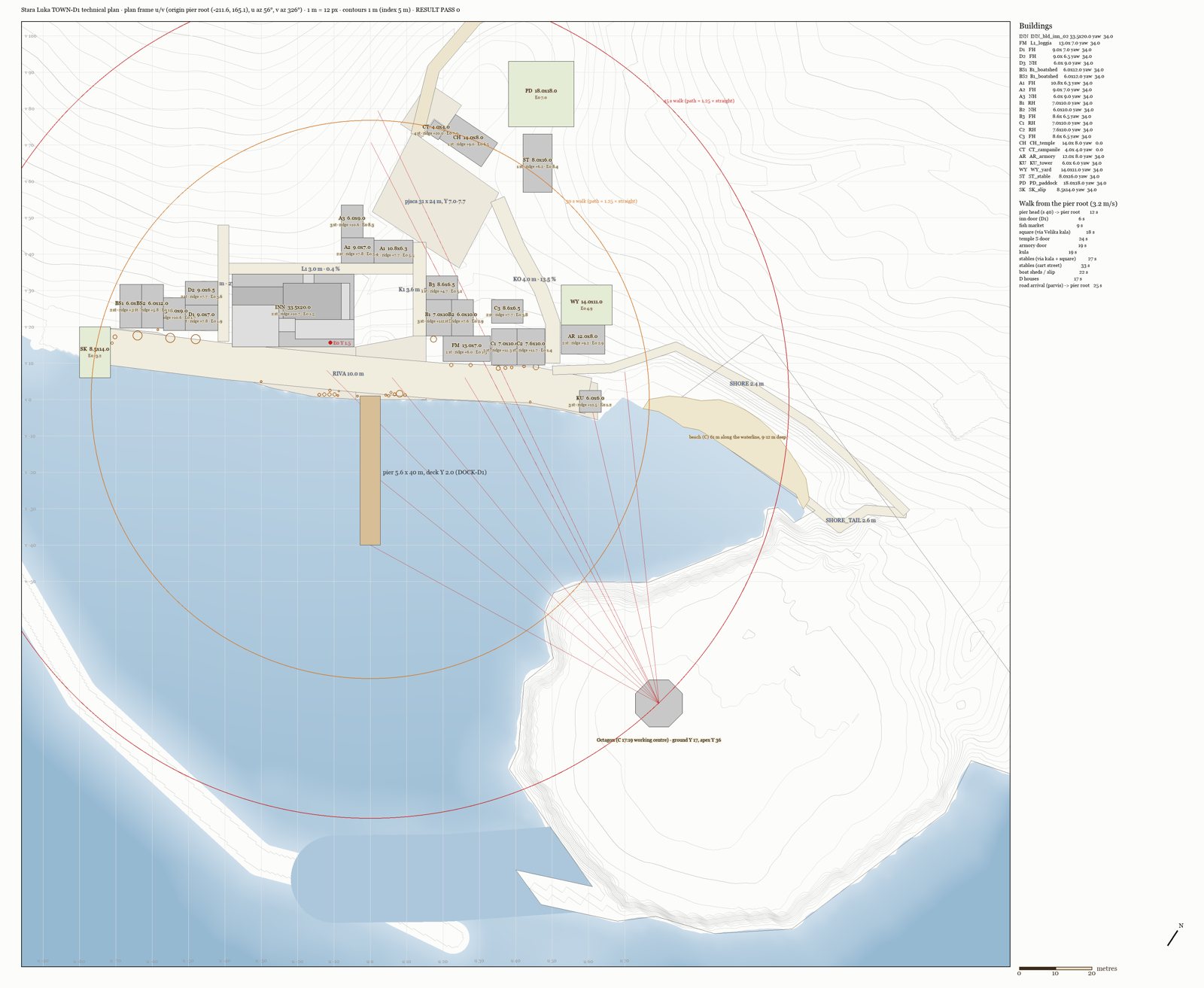 Lane widths and walk rings in the town plan | |
| Type | Gameplay system |
| Input | Click-to-move; optional WASD |
| Pathfinding | Navmesh (agent radius 0.4 m) |
| Owner | godot-integrator |
| Status | In the Godot test harness |
Click-to-move
Click-to-move is how the party walks in LOAA: click a spot and the selected character finds a path on the navmesh; optional WASD keys steer directly.
Pathfinding
- A navmesh covers every walkable surface, with an agent radius of 0.4 m.
- Paths must stay at least 1.5 m clear, so two characters can pass each other.
- Navigation is tested with fixed routes and camera probes in Godot. The demo slice passes its landing route 5/5 and the inn-to-riva route 17/17.
Stairs walk on invisible ramps
The director's rule of 2026-09-29, "the WoW trick": every stair has an invisible ramp for collision and navigation, one smooth slope through the step noses, while the render stays stepped. Each step renders as one solid block, with no grout lines. The navmesh accepts slopes of at least 40°.
Sizes that keep movement smooth
- Doorways at least 2 m wide and 2.6 m high.
- Stairs at least 1.5 m wide, each rise at most 0.25 m.
- A clear 3 × 3 m in every main room.
- Lanes and stepped lanes 2.4–4 m wide in Stara Luka.
Walk times
The plans measure distances at 3.2 m/s. In Stara Luka everything is within about 45 seconds of the pier root; the shore path to the cemetery takes about 40 seconds.
See also
Sources: CLAUDE.md (Camera and play; Building archetypes); docs/decisions.md (2026-09-29 10:25, 13:10); docs/project-summary.md; docs/towns/island1/stara_luka_town.md §4 Last updated: 2026-09-29 (WIKI-1)
Categories: Gameplay · Movement