| The Illyrian hillfort | |
|---|---|
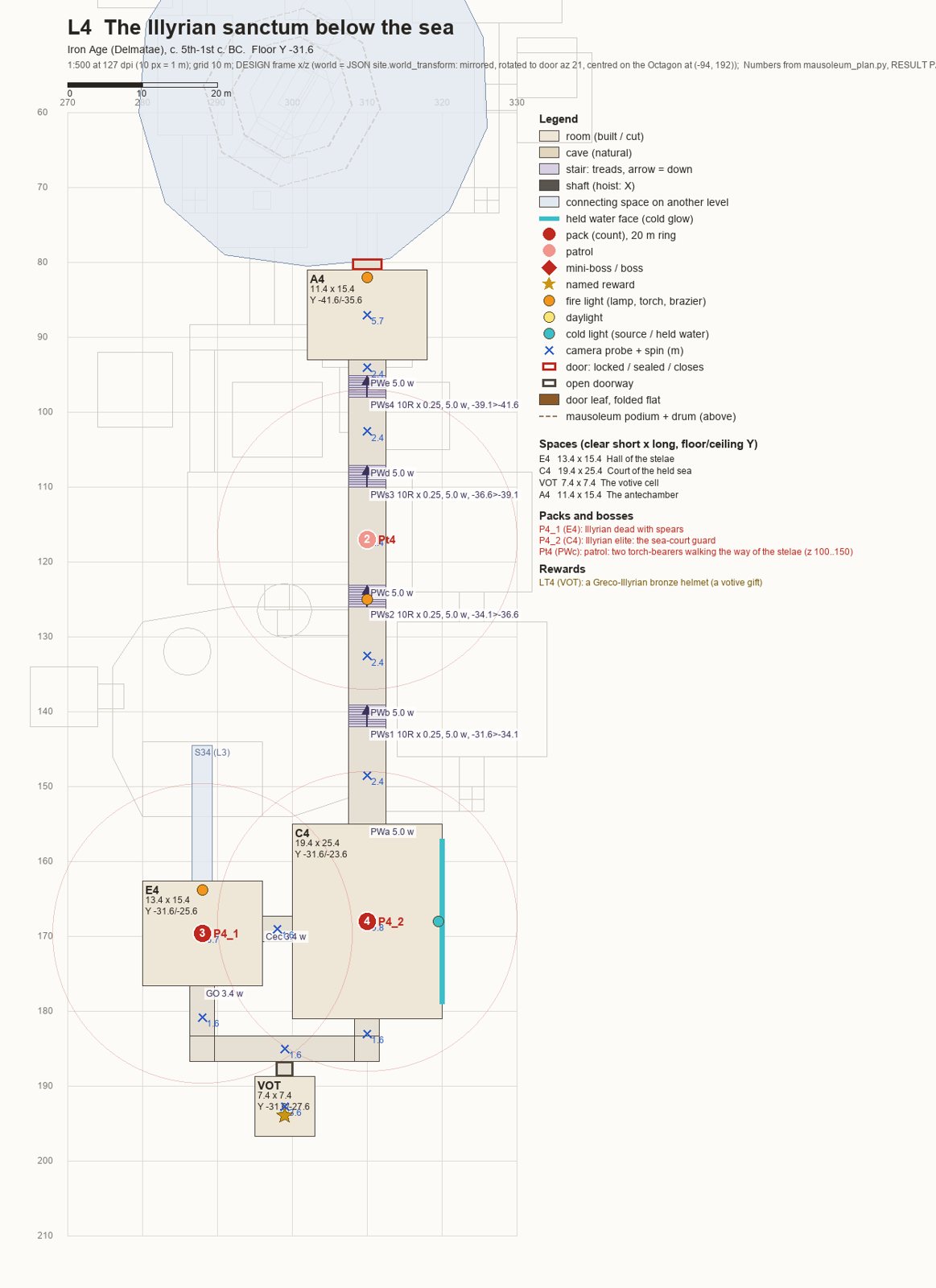 Level L4: the Illyrian sanctum beneath the Glavica | |
| Type | Lore: hillfort (gradina) and sanctum |
| Era | Iron Age, about 5th–1st century BC |
| Builders | The Delmatae (an Illyrian people) |
| Location | Crown of the Glavica, and the sanctum below the sea |
| Status | Canon in the plans |
The Illyrian hillfort (the old gradina)
The old gradina is the Iron Age hillfort that once crowned the Glavica, long before the Roman tomb or the town's cemetery. Beneath it lies its deeper secret: a sanctum below the sea.
Not to be confused with Gradina, settlement #4 on the island's ridge saddle (Settlements of Island 1). A gradina is the local word for a prehistoric hillfort.
The hillfort
The crown of the knoll was an Illyrian hillfort. The later Roman tomb and the medieval cemetery were both built on its ground.
The sanctum
Below the hillfort, where a karst cave reaches the drowned sea caves, the Delmatae built a sanctum around something that holds the sea back. - Cyclopean dry-stone walls of huge polygonal blocks, corbelled passages. - A hall of stelae, a processional way of the stelae lit by torches, a gallery of offerings and a votive cell, where a Greco-Illyrian bronze helmet still lies. - The court of the held sea, where a wide mouth opens onto a drowned cave and the sea stands as a vertical face. - A cut stone dais in the great collapse chamber below, where the source rests.
Found, not made
Illyrian walls stand at 10 m below sea level, and they are dry. That means the sea was already being held back before the sanctum was built. The Delmatae found the source; they didn't make it. What the source is remains Unconfirmed — awaiting the director.
Today
Its dead, Illyrian warriors with spears and an elite sea-court guard, still keep the sanctum in the dungeon's level L4.
See also
Sources: docs/towns/island1/stara_luka_mausoleum.md §1, §3 (L4–L5); docs/towns/island1/stara_luka_cemetery_plan.md §1; docs/decisions.md (18:05 naming) Last updated: 2026-09-29 (WIKI-1)
Categories: Lore & History · Glavica