| The Roman tomb | |
|---|---|
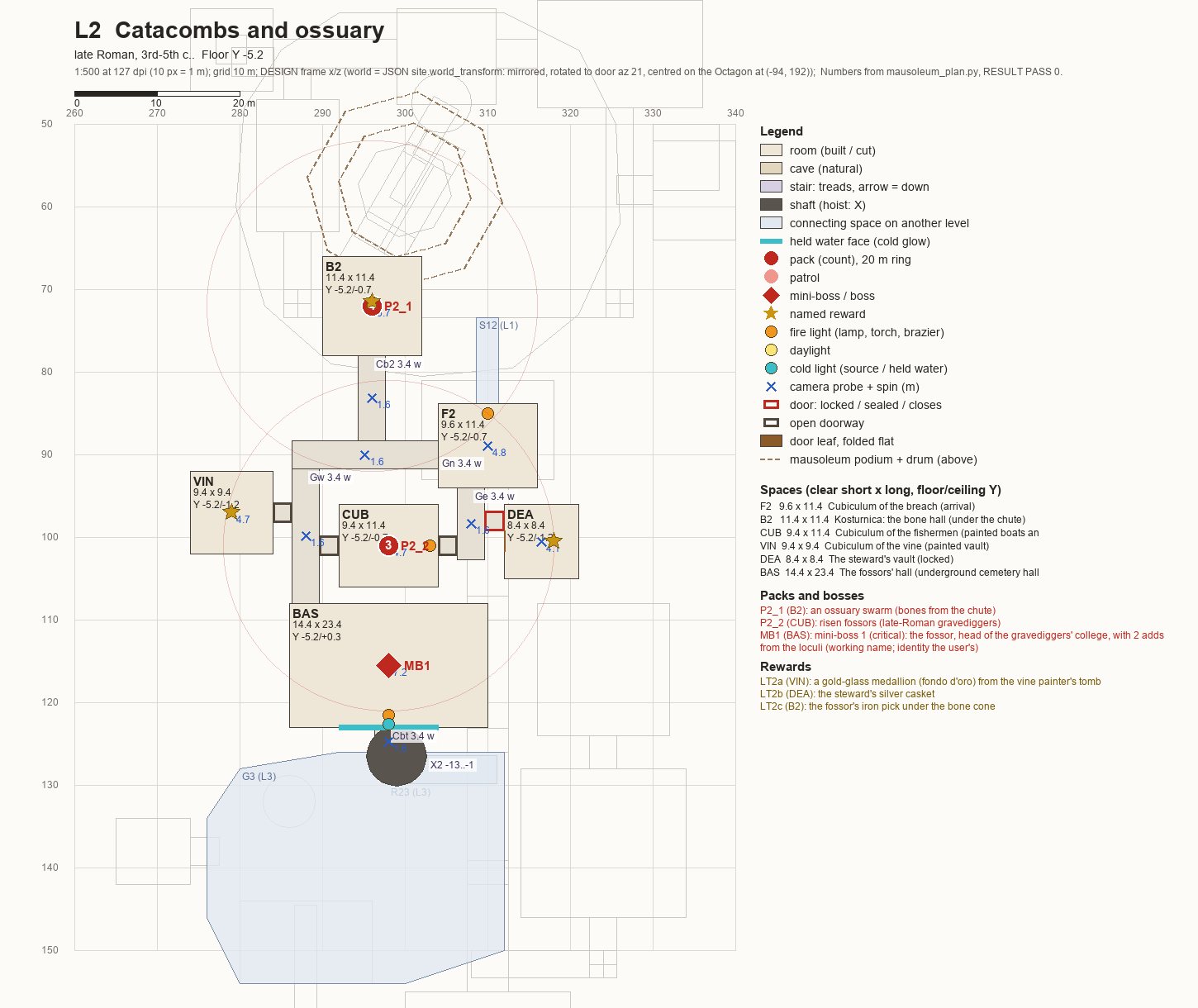 Level L2: the late-Roman catacombs | |
| Type | Lore: tomb, catacombs, cistern |
| Era | Late Roman, about 3rd–5th century |
| Builders | A late-Roman official; the fossores (gravediggers) |
| Location | The Octagon and the rock below |
| Status | Canon in the plans |
The Roman tomb
The Roman tomb is the Octagon in its first life: the octagonal tomb of a late-Roman official, raised on the crown of the old Illyrian hillfort, with catacombs cut into the rock beneath it.
The tomb
- A late-Roman octagonal tomb of the governor's-officer class, built by a villa owner on the hillfort crown: a podium, a drum and a domed rotunda, in big dressed blocks.
- Its first owner was buried in the podium crypt; a sealed loculus there still holds a gilt crossbow brooch, the badge of his rank.
- Its sarcophagus was robbed long ago.
The catacombs
- Late-Roman fossores, the gravediggers' college, cut galleries (ambulacra) along a soft bed in the rock, with loculi stacked four or five high.
- Painted chambers (cubicula) tell who was buried there: boats and nets for a fishing family, a vine for a wine merchant.
- They cut an underground cemetery hall over a founder's grave.
- Digging south, the fossors broke into a natural shaft, walled the gallery off and never finished the hall's apse; its south wall is still raw rock with tool marks.
The cistern
In the karst cave below, the Romans built a cistern to collect the drip water: 20 × 18 m, four piers, barrel vaults. A pot of late-Roman coins lies in the salt hall beside it.
Reused
Around the town, reused Roman sarcophagi still line the cemetery's processional way. About 1340 the tomb itself passed to a patrician family: see The patrician family.
Real-world grounding
Diocletian's mausoleum in Split (a Roman octagon later reused), and the late-Roman cemeteries of Salona (Manastirine and Marusinac).
See also
Sources: docs/towns/island1/stara_luka_mausoleum.md §1–§3 (L0, L2, L3); docs/towns/island1/stara_luka_cemetery_plan.md §1, §5 Last updated: 2026-09-29 (WIKI-1)
Categories: Lore & History · Glavica