| The Octagon | |
|---|---|
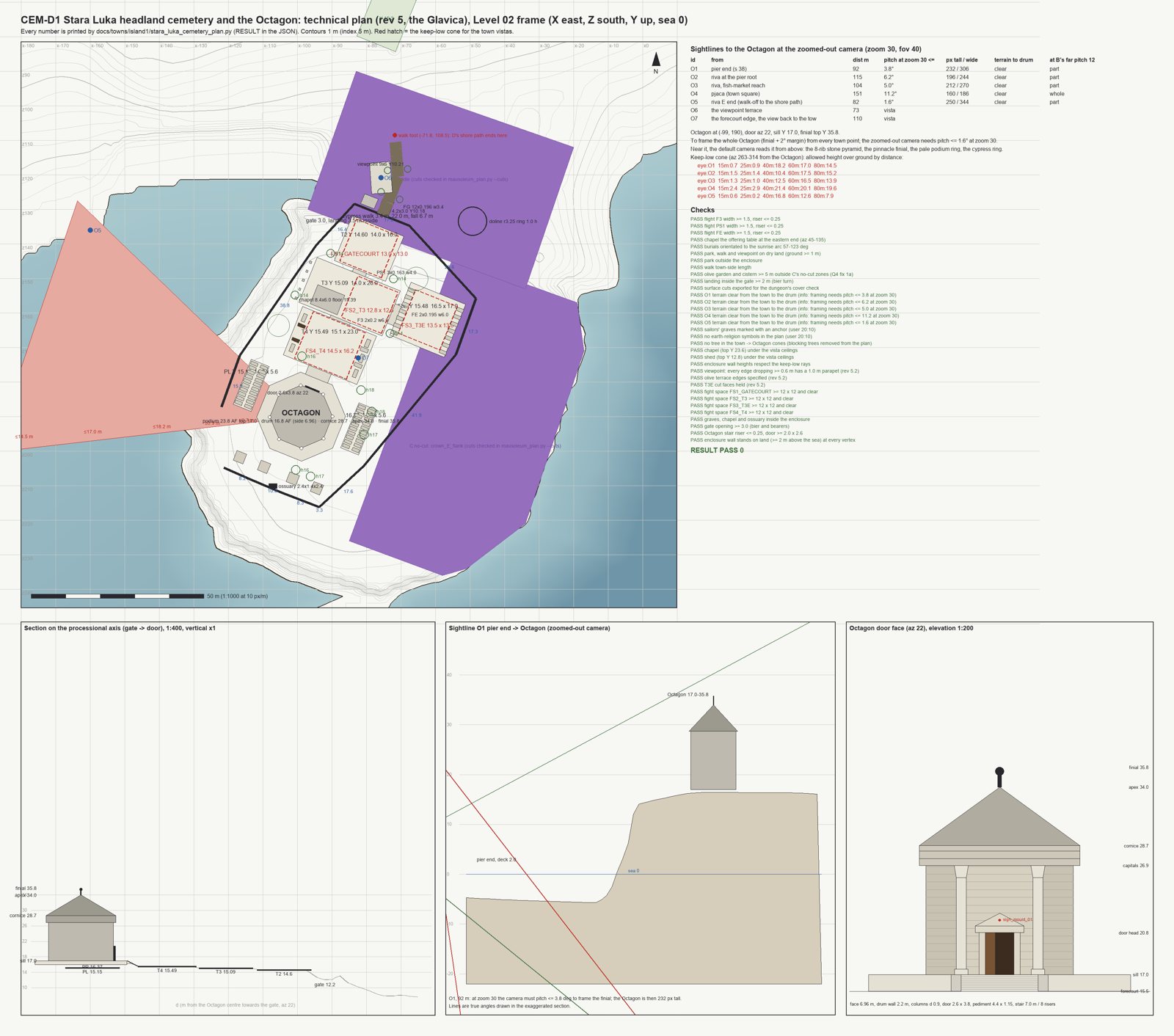 Technical plan of the cemetery and the Octagon (rev 5.3) | |
| Type | Mausoleum (late-Roman octagonal tomb) |
| Asset id | bld_mausoleum_med_entrance_01 |
| Location | Crown of the Glavica |
| Regional style | A (older strata of the same limestone) |
| Affiliation | Built for a late-Roman official; the patrician family's tomb since about 1340 |
| Size | Podium 23.8 m across; drum 16.8 m; finial top 18.8 m above the sill |
| Status | Planned; blockout reviewed (MAUS-X1) |
The Octagon
The Octagon is the great mausoleum on the crown of the Glavica: a late-Roman octagonal tomb, taken over in the Middle Ages by a patrician family, and the entrance to the dungeon below. From the town it is the landmark across the water: 91 m from the pier head, 116 m from the pier square, 151 m from the pjaca.
Architecture
| Part | Description |
|---|---|
| Podium | an octagon 23.8 m across, with a plinth, a torus moulding and cap slabs |
| Ring walk | 3.5 m round the drum, like the peristyle walk of Diocletian's mausoleum in Split, its colonnade gone; fallen column drums lie on it as cover |
| Front stair | 7.0 m wide, eight solid steps with cheek walls |
| Drum | 16.8 m across, walls 2.2 m thick, of big dressed ashlar in painted courses |
| Columns | 8 engaged columns on the corners, with bold capitals |
| Entablature | architrave, a plain frieze (no text) and a cornice |
| Roof | an octagonal stone pyramid of slab facets with 8 raised hip ribs |
| Finial | a plain carved stone pinnacle (a knob on a square shaft), 1.8 m, the family's addition |
| Door | 2.6 × 3.8 m, two brown oak leaves with iron straps: the left open, the right ajar; a pedimented frame with a plain tympanum |
| Windows | two arched slits with iron grilles |
| Wear | moss and dark streaks on the north faces, lichen on the roof, cracked ring slabs, ivy on the NE face, soot at the door head |
The silhouette the director approved is kept, but since 2026-09-29 the top is a stone finial, not a cross, by the rule against real-world religious symbols.
Seen from the town
From above, the default camera reads the pale podium ring, the eight-faceted stone pyramid with its dark ribs and finial, and the ring of cypresses. The far, flattened camera frames it whole from the pjaca, and short vista beats frame it from the waterfront (see Camera). Nothing tall is allowed between the brow and the Octagon, so it always reads from the harbour.
Inside
Daylight falls through the door onto the rotunda floor, and at the back an open stair well glows orange from the family's sanctuary lamp. The family broke a stair through the Roman floor into the podium crypt and cut on down; the crypt's robbed sarcophagus lies beside the medieval steps. This is level L0 of the dungeon.
History
- A late-Roman official's tomb, built on the crown of an older Illyrian hillfort.
- About 1340 a patrician family took it as their family tomb and set the stone pinnacle on its roof.
- The town then buried its dead around it. See The Roman tomb and The patrician family.
Real-world grounding
Diocletian's mausoleum in Split (an octagon about 13 m inside, later reused), and the Račić mausoleum above Cavtat.
At night
The Octagon's single lamp and the kula's beacon in the town face each other across the harbour.
See also
Sources: docs/towns/island1/stara_luka_cemetery_plan.md §1–§3; docs/towns/island1/stara_luka_mausoleum.md §3 (L0); docs/towns/island1/stara_luka_town.md §5; docs/decisions.md (20:10) Last updated: 2026-09-29 (WIKI-1)