Meneferu
| Meneferu | |
|---|---|
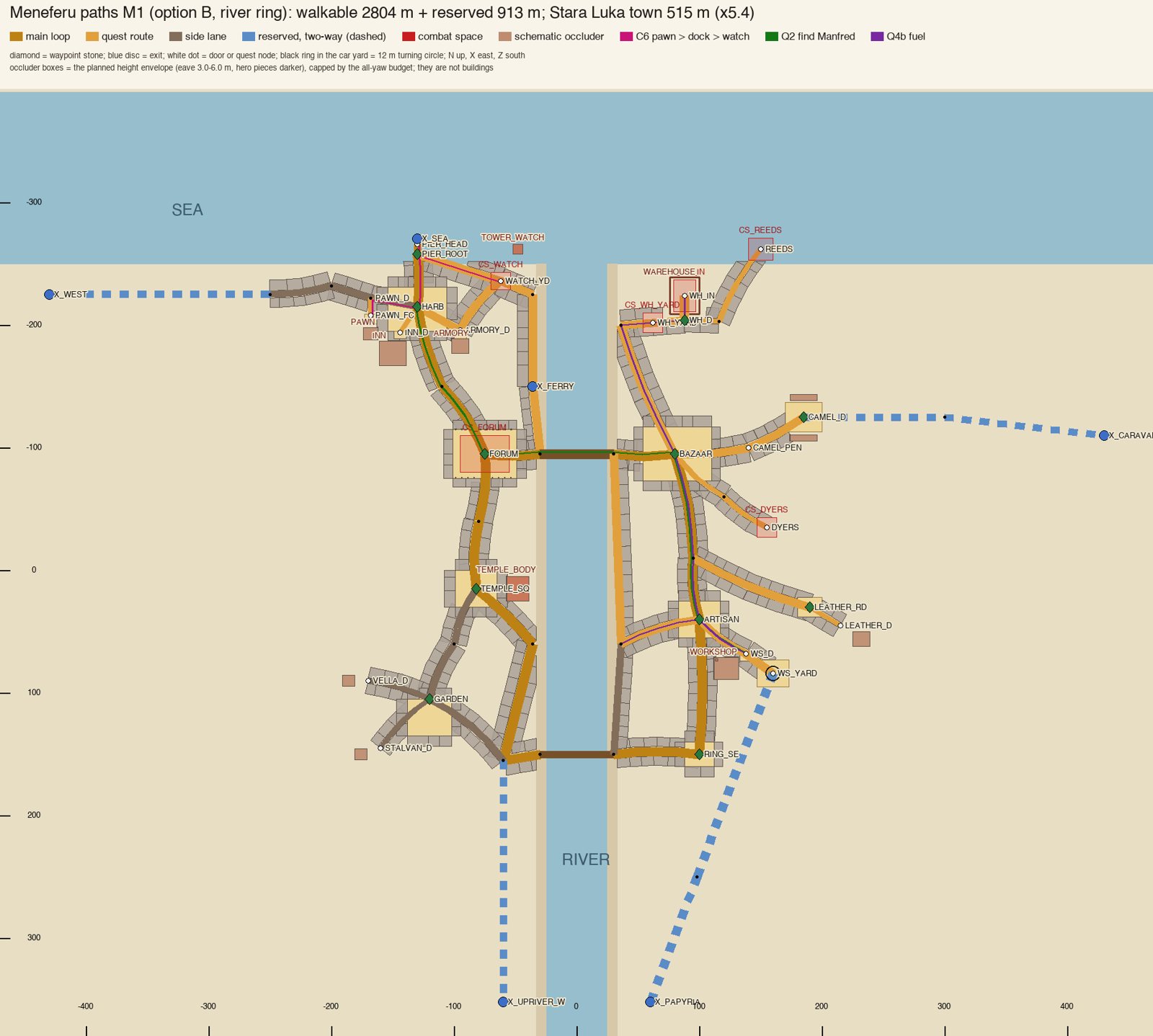 The path network (option B, the river ring), rev M1 | |
| Type | Town (the Chapter 4 hub) |
| Location | Island 2, the desert north, just past the river delta on the apex pool |
| Regional style | Meneferu desert architecture (one style for the whole town) |
| Affiliation | Unconfirmed — awaiting the director |
| Size | about 840 × 590 m (0.50 km²); 2,888 m of walkable paths plus 931 m reserved |
| Plan | meneferu_town_plan.md; meneferu_paths.md |
| Status | In the game: the whole town is walkable, dressed and peopled; Chapter 4 plays here, and the Papyria arc returns to it |
Meneferu is a desert port and caravan town on the river delta of Island 2, Stalvan's home and the hub of Chapter 4 of the Prologue.
Overview
- A working town, not a rich one (the director, 2026-10-16): a trade junction with no elite. Warehouses, caravan yards, the market, workshops, stables and a sailors' inn; no palaces, grand villas or gilding.
- A town without walls, on flat land with the river through the middle. There are no hills, rocks or dunes inside the town.
- Big: the director asked for a town "definitely bigger than Stara Luka". Its footprint is about 10× Stara Luka's, and its walkable streets about 5.6× the Stara Luka town's (2,888 m against 515 m).
- Papyria, the elite city with the great library, lies across the sand on the fortified east coast, and its look is meant to contrast with Meneferu's.
Geography
- On the world map (version 10, accepted 2026-10-22) Meneferu lies on the sand just past the river delta. Its water front faces the apex pool, where the delta branches start.
- The river runs north through the town, about 50 m wide, widening to about 100 m where it meets the pool.
- Every grade in town is under 1 %. A low old mound lifts the forum about 1.4 m; a lower one sits under the bazaar.
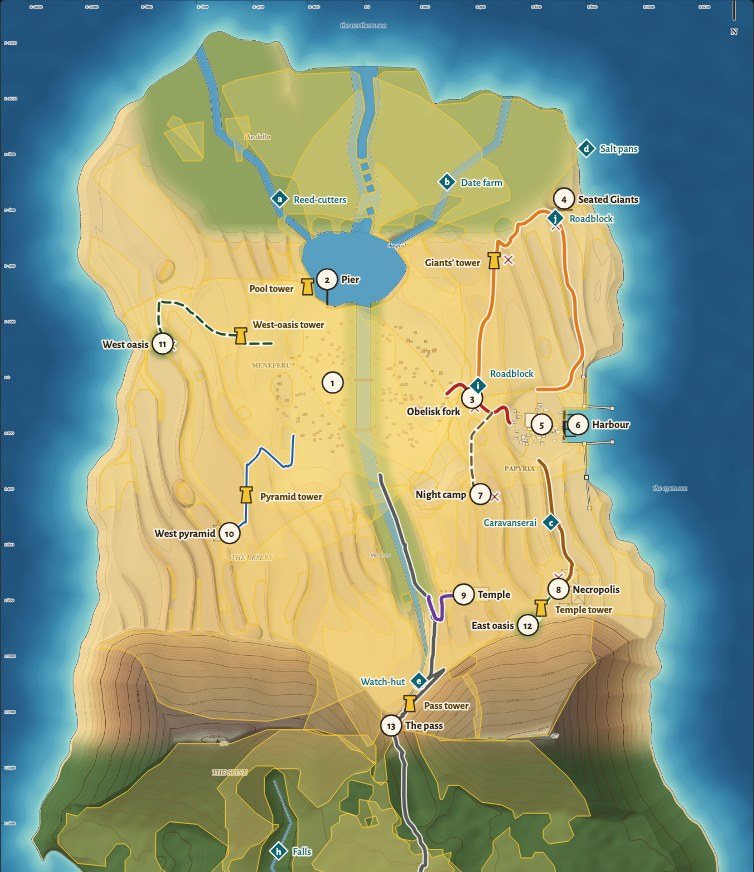
Island 2 on the world map, version 10 (planning). Meneferu is place 1, by the pier on the apex pool.
Districts
| District | Bank | Holds | Landmark | Accent colour (cloth only) |
|---|---|---|---|---|
| Harbour | west, on the pool front | the pier, the harbour square, the inn, the armory, the pawn shop, the watch yard | the watchtower where the river meets the pool | indigo |
| Forum and temple | west, on the river edge | the forum (the hub), the temple and its square | the forum's columns; the temple tower | pale gold sandstone |
| Gardens | west, south | Vella's and Stalvan's houses, the palm-garden square | a sycamore fig over the well | leaf green (plants only) |
| Bazaar | east, at the bridgehead | the market, the dyers' court, the camel yard | the market's cloth canopies | madder red |
| Quays and artisans | east | the dockside warehouse, the reeds, Manfred's workshop and car yard, the leatherworker, the road to Papyria | the workshop's wind-catcher and the car yard | soot and copper |
Landmarks
- The shore dock: since 2026-10-24 the long pier is gone; only its head stays, as a small 20 × 8 m timber dock lying along the harbour shore, with the trabakul berthed broadside to it (see "Step 4" below). The town needs no long pier, since Stara Luka has one (the director). The plan's first pier was 92 × 6 m with a T-head of 36 × 10 m.
- The forum: an old-empire ruin reused as a trading square, with weigh-scales, porters' benches, bales and stalls between broken columns. It is the town's hub and waypoint.
- The Old Bridge (8 m, stone, from the old empire) and the Boat Bridge (5 m, a pontoon) cross the river.
- The watchtower (18 m) at the west-bank tip where the river meets the pool.
- The temple: modest, old and functional; a 14 m tower on a 9 m body, facing west onto its square. Architecture only, with no symbols.
- The inn: two storeys on the harbour square with a low dome; open to play.
- Manfred's workshop and car yard: one storey with a wind-catcher; the yard beside it is 26 × 22 m, room for the car to turn.
- Shops and houses: the armory is a shop only (weapons and armour). The pawn shop on the harbour's west street holds Stalvan's pawned armour (the director, 2026-10-16). Stalvan's and Vella's houses are ordinary closed homes in the gardens district.
- Also planned: the market, the leatherworker, the camel yard and the dockside warehouse.
Style
Desert architecture inspired by the Nile delta and Saharan mud-brick towns, painted rather than photographic.
- Forms: thick, inward-leaning mud-brick and plastered walls with rounded corners; flat roofs with parapets and roof terraces; low domes and barrel vaults on public buildings only; wind-catchers on the workshop, the inn and the warehouse.
- Details: small deep-set windows with plain brown wooden screens and shutters; shaded arcades and courtyards; palm-trunk beam ends; palm-frond shades; cloth canopies over the market stalls; mud-brick river quays with timber fenders.
- Palette: pale packed sand on the paths (the brightest band on screen), warm ochre and sand walls, darker mud-brown roofs, plain brown wood, and indigo, madder red and faded saffron on cloth only.
- Never used: minarets; any symbol on a dome (finials are a plain brass ball or a clay knob); hieroglyphs or any text; glowing ornament; arches copied from a real building. Nothing in the town carries text or signs.
- Dressing: palm-rib and reed fences, low garden walls and timber rails that guide the eye but never block a path; bronze braziers at the squares; iron wall torches along the main loop, closer together near each door that matters.
Plants
Chosen to be true to the Nile delta:
- Quays and the river edge: rows of date palms on the land side; papyrus and common reed in the water margin; lotus and water lilies in still water only.
- Squares and gardens: one sycamore fig per square as the big shade tree; date palms in courtyards; Christ's-thorn jujube in yards.
- Yards and roofs: vines on pergolas over yards; potted herbs.
- Town edge: acacia and tamarisk.
- Not here: lawns, olives, cypress, pines, agave or bougainvillea.
Paths and the camera
Meneferu is planned paths first, camera first (Zone layout).
- The river ring: a closed main loop of 837 m crosses the river twice, over the Old Bridge and the Boat Bridge, so neither bank is a dead end.
- Twin hub: the forum on the west bridgehead and the bazaar on the east, 140 m apart across the Old Bridge.
- The network: 57 segments, 52 nodes, 14 squares, 6 flat fight spaces and 2 bridges. Eleven waypoint stones keep every town node within 34 s of one.
- Street widths (widened 2026-10-23, see below): the main loop 8 m, quest streets 7 m, side streets 6 m, every lane 4.5 m. The squares and the town route are unchanged.
- The camera: fixed at 55°, looking east, so the top of the screen is east. A building's height follows its lane's width (
h_edge ≤ 1.75 + tan(pitch) · w / 2). On north–south lanes the west side, nearest the camera, stays one storey; second storeys, wind-catchers and palms go on the east side. Tall pieces stand only where nothing walkable hides behind them: the watchtower and the temple have the river behind them. - Exits: six, all two-way: by sea from the shore dock (the old pier head), the road to Papyria from the car yard, the caravan road east, the coast road west, the road upriver, and a ferry landing. In Chapter 4 all but the dock are closed by props, and later chapters open them without moving a path.
The town today
What a player finds in Meneferu.
Arriving
- The ship lands at a small timber shore dock (20 × 8 m) lying along the harbour shore, with the cargo trabakul berthed broadside and its gangplank on the dock edge. There is no long pier here; that one is in Stara Luka.
- Nakhti (Unconfirmed, working name), a young watchman of Captain Ruhet's harbour watch, stands at the pier root to meet arriving boats. He points newcomers to people with work: to Sabu, the mummy seller ("We need coin."), and to Medjira, who sells Ember Powder ("Anything for a blade?"). Each lead is worth 25 XP when the party reaches the person (Small quests). When no lead is left he says: "That's everyone I know who pays. Enjoy Meneferu."
Streets and houses
- The whole town is walkable, about 3.2 km of routes: the main loop, the harbour spur, the quest routes and both quay lanes. The main loop is 8 m wide, quest streets 7 m, side streets 6 m and lanes 4.5 m.
- Houses: closed, kit-built desert houses in one style: mud-brick and lime plaster, darker flat mud roofs with parapets, plain brown shutters and doors. Many roofs are terraces with floors, tents, benches, tables and plants.
- The ground is laid flagstones in broken rows with painted joints and a kerb along the street edges.
- In the streets: statues of the old gods (inspired by ancient Egypt; who the old gods are is Unconfirmed — awaiting the director), mummy stalls (mummies for sale, not undead), low stone walls, fountains, market stalls with awnings, rugs and rows of clay jars.
- The five ways out of town read closed: a cart and crates, rope lines, logs, and the ship at the dock.
Landmarks and squares
- West of the river: the temple (its west door on its own square, a tall body and a tower), the watchtower by the harbour, the inn ("the Sailors' Rest"), the armory, the pawn shop, and the forum ruin: 16 columns from the old empire, before our time. Six quays line the water.
- The bridges: the Old Bridge, of stone, and the Boat Bridge: nine tarred hulls under a plank deck with rope rails.
- East of the river: the bazaar square, the warehouse with its big cart gate, the market hall, the camel stables and their yard, the workshop with its car yard, and the leatherworker.
- The bazaar has market rows with stalls, canopies, crates of produce, rugs and scales; the forum holds a weigh market; the harbour has fish-sorting gear and cargo; the sand beside the shore dock has the catch, net coils, baskets, jars and low shrubs.
- Open to walk in (in the story): Manfred's workshop, the dye house on the dyers' court and the warehouse hall. The inn stays closed; Imsa talks at its door. Every other building is a closed shell you walk around.
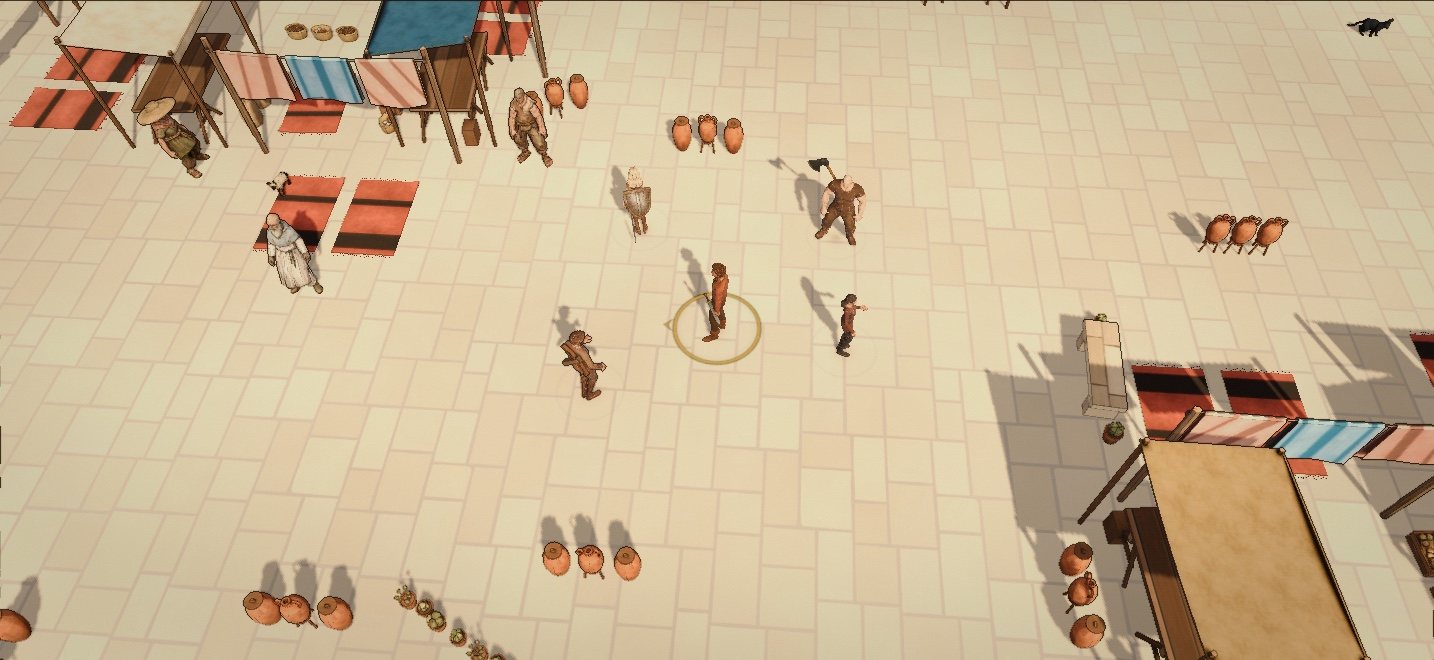
The bazaar at 16 m zoom, late afternoon: stalls with awnings, rugs, rows of clay jars, townsfolk.
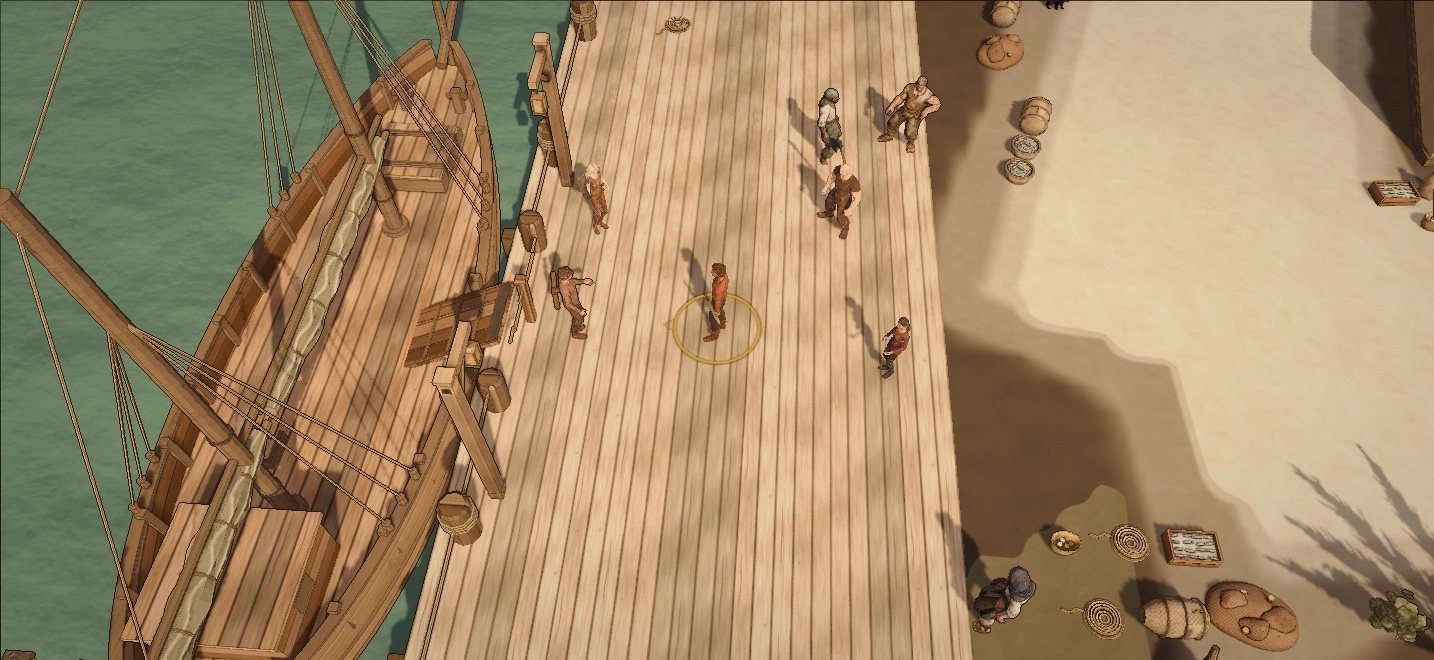
The shore dock at 16 m zoom, late afternoon: the dressed sand beside it (the catch, net coils, baskets, jars, shrubs).
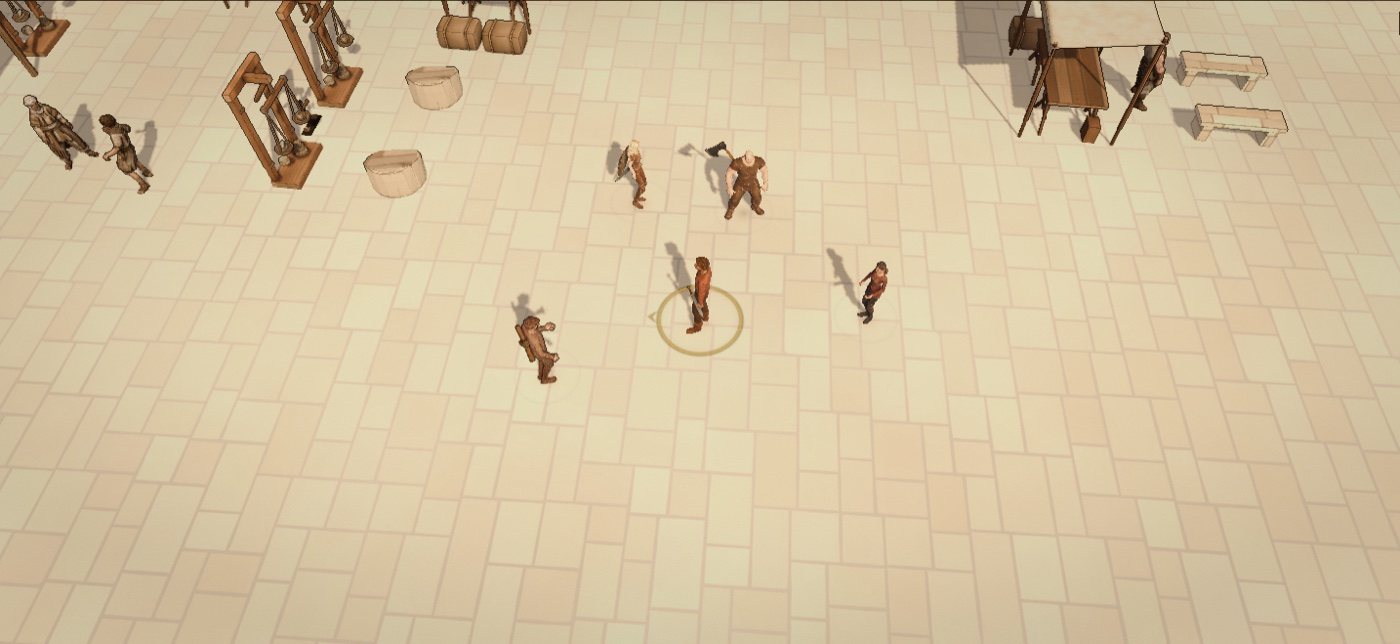
The forum at 16 m zoom: the act 1 weigh market.
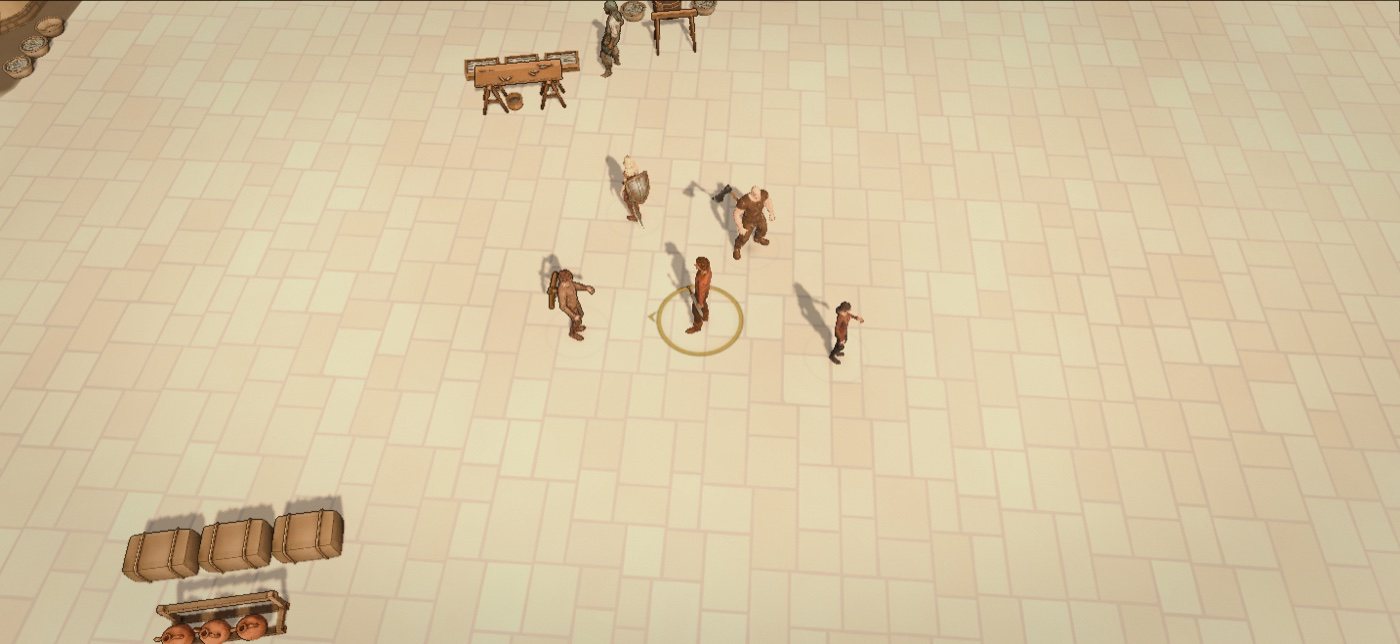
The harbour at 16 m zoom: fish sorting and cargo.
People and animals
- Townsfolk walk, idle and talk among themselves in the streets and squares; they have no spoken lines, only the named people speak.
- Cats in four coats (Siamese, black, white and a grey tabby) live at about ten quiet edge spots; they bolt when the party comes within about 6 m and walk home after.
- Camels stand in the stables yard and the pens; riders loop on the wide streets and squares and give way to the party. Hesuk's camel Sefa is one of them.
Plants and night
- Papyrus, common reed and tamarisk by the water, date palms along the quay, figs in the squares and courts.
- At night, rows of lanterns light the streets: wall brackets, hung lanterns and a lamp gallows.
What hides, and when
- When a tall landmark or a big building stands between the camera and the party, it fades as one whole piece and comes back shortly after the party has passed.
- A tree fades as one whole element, and only for the character the player controls.
- Nothing on open walkable ground hides the party: props there that do not fade are at most 0.9 m tall.
The story here
- Chapter 4 plays in order: Nakhti's leads, Imsa at the inn, Manfred's workshop, Tefi's news, the gear and the fuel, the engine, the drive out and the car fight. Every spoken line is on the Chapter 4 script.
- Saves: the inn, the start of each parallel step, and the car yard; a party wiped anywhere in Meneferu restarts at the last save.
- Later, the Papyria arc's seventh part begins with first light in Meneferu; the town and the necropolis are one place on Island 2 (Papyria).
In the story
As the Prologue tells it (Chapter 4, The Inventor):
- The captain puts the party off at Meneferu; nobody sails further. The ship sails into a river-delta city of domes, markets and heat haze, and Stalvan is home.
- No caravan will go to Papyria, but an innkeeper points the party across the river to Manfred.
- In his smoking workshop they meet Manfred. A messenger, Tefi, runs in: men in ochre sashes have seized the library, and Zanze, the Keeper, holds the inner door alone. In the game Tefi carries a folded page from her ledger, and Manfred knows at once she is in trouble.
- At the camel market Stalvan, in Manfred's borrowed welding goggles, asks a camel merchant for his camel.
- The drive to Papyria in Manfred's car starts from the car yard. In the game the party first finishes the car (Help Manfred finish the car): the gear from Dosh's dyers' court and Hesuk's camel pen, the fuel from the warehouse the ochre-sash scouts are draining. The drive out ends Chapter 4 in the game; the story plan counts the drive as Chapter 5.
- Stalvan pawned his armour in Meneferu before he took the party's job. In Chapter 6 the party gathers again in Manfred's workshop.
- Side quests (story design, STORY-QUESTS-1, 2026-10-25): they open on arrival, before the workshop, and stay open in Chapter 6. A Light in Stalvan's Window (big: Ipu's bakery on the palm-garden square, Stalvan's court in the gardens district, the pawn shop on the harbour west street, the bazaar's back stalls, the ferry landing), Overdue (the temple archive and the fish stalls), Eyes on the River (the watch yard, the watchtower top, the reeds) and Grandfather of the Reeds (Senna's workshop, the reed bars). Scripts: Quests in Meneferu. Their named givers' talks and first steps are in the game since phone build v0.1.143.
- The Mummy Thread (in the game, MILESTONE 2026-10-28): Sabu, the mummy seller, sends the party to Hetsa, the ruined House of Linen in the desert east of town. All small quests: Small quests.
See also
- Island 2 (Desert and Jungle)
- The Prologue
- Manfred (Manfred) · Zanze · Stalvan
- Stara Luka, for scale
- Paths first, camera first
- Ember Powder and the Fiery Blade: Medjira sells Ember Powder at her bazaar stall
- Hetsa, the ruined temple east of town · The Mummy Thread · Small quests
- Quests in Meneferu · Manfred's car · Chapter 4 script: Meneferu
- Locations portal
Sources: docs/plan/meneferu_town_plan.md (user decisions, §0–§7); docs/towns/island2/meneferu_paths.md and meneferu_paths.png (MEN-PATHS-1, rev M1); docs/towns/world/shots/world_v10_island2.jpg; wiki Lore/The_Prologue.md (Chapter 4); queue.md 2026-10-23 (MEN-MAP-SYNC, MEN-START-1, MEN-KIT-0, MEN-TOWN-PLAN, PARTY-5) and 2026-10-23/24 (MEN-WIDEN-SYNC and the phone builds v0.1.126–v0.1.129); main session facts 2026-10-24 (Meneferu step 2, phone builds v0.1.130–v0.1.132); engine frames from MEN-ASM-2d; main session facts 2026-10-24 (Meneferu step 3, phone build v0.1.134) and the step 3 boards; docs/towns/island2/meneferu_widen_options.png; main session facts 2026-10-24 (Meneferu step 4: MEN-DOCK-1, MEN-ASM-4-II); data/meneferu_grey/meneferu_fill.json and meneferu_plant_species.json (plant counts); docs/decisions.md 2026-10-24 18:1x and 18:2x; the MEN-DOCK-1 boards; docs/plan/meneferu/men_walk_review_card.md §9–§10, docs/quality/reviews/men_walk_review_2026-10-24.md, docs/decisions.md 2026-10-24 19:4x–20:4x and S6, queue.md (MEN-WALK-REVIEW, MEN-NOCROSS-1) and their boards; docs/decisions.md (2026-10-24 21:4x MEN-LOOK-PLAN, 22:2x MEN-PAINT-1a, 22:3x pause); data/release_log.json (v0.1.138, v0.1.139); main session facts 2026-10-27 (MEN-LOOK-RECORD: the look stage milestone) and the boards in men_look/swap/live and men_look/asm2/clip; data/release_log.json (v0.1.143); docs/plan/meneferu/mummy_quest_stage_cards.md; main session facts 2026-10-28 (MEN-DRESS-2: the street dressing milestone, phone build v0.1.147), docs/towns/island2/meneferu_dress2.py, the live smoke frames in men_dress2/asm/checks_r2h2; docs/plan/meneferu/arrival_leads_plan.md and main session facts 2026-10-28 (LEADS-1, LEADS-P); queue.md and card_logs (MEN-CATS-3, MEN-CAMELS-3/3b, MS-W, E2E-MEN-1, DF-P, MEN-SAVE-PAR-1, DF-PERF-1..3, MQ-BARKS-1, MQ-RETRY-1, PHONE-WRAP); data/demo/meneferu_story.json; data/ui/dev_jumps.json (meneferu_story)
Last updated: 2026-11-19 (WIKI-CLEAN-2)