Paths first, camera first
| Paths first, camera first | |
|---|---|
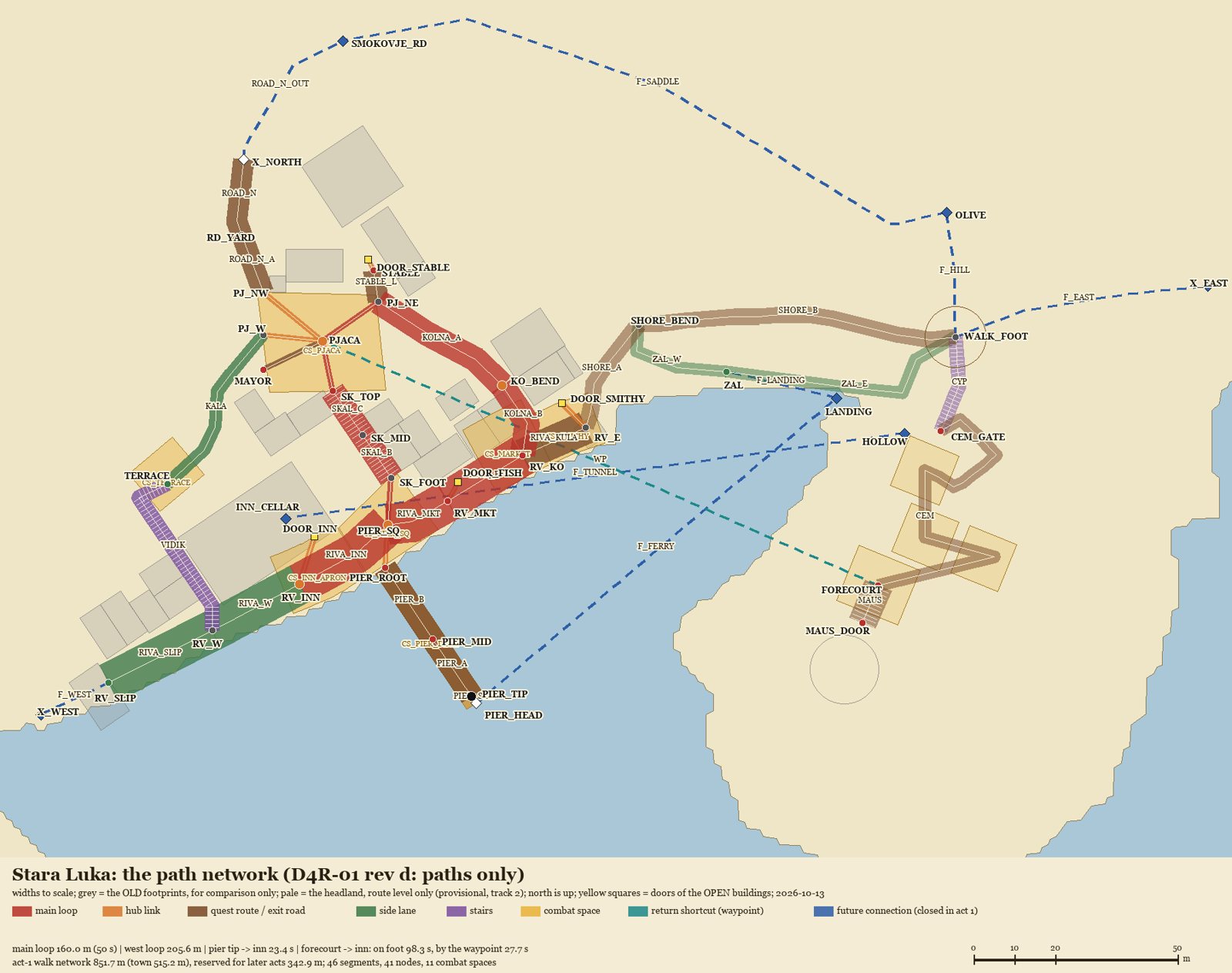 The path network of Stara Luka, the first town rebuilt this way | |
| Type | Standing rule (map and town layout) |
| Decided | 2026-10-08 (director) |
| Reference | Diablo IV towns and buildings |
| Replaces | The realistic-town planning |
| Status | Confirmed |
Paths first, camera first is how TLOAA lays out every zone, town, village and outdoor level. The paths are planned before anything else. The world stays open, so the party can come back to every town. Building heights are set so the camera never loses the party, as in Diablo IV.
The director's words
On 8 October 2026 the director said: "the plans for creating the map is to first create all available paths for the zone, keep in mind that we will have pretty open things in the next acts so we can return to the towns, and that we plan the height of buildings so they match the diablo 4 gameplay and that the game is good for camera, we used to create the realistic town but we will use this new philosophy instead".
He also said: "we just wanted to make sure the player can play like in diablo so the camera is not stuck".
What changed
- Before: a town grew like a real medieval town, around plots, trades and real storey heights. The streets were the space left between the houses. Some lanes ended up hidden from the camera behind tall houses.
- Now: the paths are the design. The houses are set around them, and the camera decides how tall they may be.
- What stays the same: the look. Every regional style stays exactly as it was, with one style per settlement, brown shutters on Island 1 and believable construction. This rule is about playability, not looks.
The order of work
- Paths, with no buildings. The whole path network of the zone is drawn and saved as data:
- the main loop from the arrival, through the hub (inn, traders, quest givers) and out to the exits;
- the quest routes;
- the places where fights happen;
- side lanes, each with a reward at the end;
- the routes back to the hub.
- Greybox walk. The paths are walked in the engine as plain blocks, to check travel times and that every place can be reached.
- Height budget. Every edge of every path gets a height limit, worked out from the camera.
- Buildings. Houses fill the blocks between the paths, each within its height limit.
- Readability pass. The walkable path is the lighter band, there is one landmark per district, and nothing tall stands on the camera's side of a street.
- Proof. A test walks every route with the camera turned four ways and checks that the party is never hidden.
We come back to towns
Later acts open up the world, and the party returns to towns it has already visited.
- Two-way exits: every exit works both ways.
- Reserved routes: routes that open later, such as gates, bridges, collapsed lanes and landings, are drawn on the path map from the first act. Opening them never means moving a house.
- Shortcuts: long routes get a shortcut back to the hub.
- Later visits: a town may change for a later visit (damage, camps, a festival, barricades). Props are added or removed, but the paths never move.
Building heights for the camera
The camera looks down at about 50–55° and turns freely around the party. A wall beside a path may only be as tall as the camera can see over. This keeps the heads of the party visible in the middle of the path:
highest edge ≤ 1.75 m + tan(camera pitch) × path width ÷ 2
| Path width | Highest edge on the main loop and fight spaces (50°) | Highest edge elsewhere (55°) |
|---|---|---|
| 2 m | 2.9 m | 3.2 m |
| 3 m | 3.5 m | 3.9 m |
| 5 m | 4.7 m | 5.3 m |
| 8 m | 6.5 m | 7.5 m |
The camera turns, so the limit applies to both sides of every path.
What this means for the houses:
- Low town houses, like in Diablo IV. On lanes up to 3 m wide, houses are one storey, with the roof edge at about 3–3.5 m.
- Two storeys only on streets at least 5 m wide (6 m on the main loop) or on squares.
- Tall buildings are landmarks. Towers, temples, keeps and mausoleums stand at the edge of the zone, against a cliff or the sea, or behind an open square, where nothing walkable is hidden behind them.
- Cutaway lanes. A lane where a wall or roof must fade away as a whole element to show the party is allowed only when the plan names it and gives the reason. The main loop and fight spaces never have one.
- One playable floor. Inside a building the party plays on one floor. Upper floors are scenery that fades away.
Land, castles and cities
On the same day the director asked how Diablo IV handles deserts, plains, mountains, forests, coasts, castles and big cities, so the camera never gets stuck anywhere. The answer became part of the rule.
Slopes are free, steps are not. A hillside rising beside a path at less than the camera's angle never hides the party, however tall the hill. Sand dunes, grassy hills and scree slopes can be any size. Only the steep parts count against the height limit: cliffs, rock steps, retaining walls and tree crowns.
The ground cannot fade, so cliffs are separate pieces. The game can fade a roof, a tree crown or a rock, but not the ground itself. Any cliff or rock wall that is too tall beside a path is built as a separate rock piece that fades like a roof.
How wide and how steep paths are:
| Path | Width | Steepest climb |
|---|---|---|
| Main road | 5–6 m | about 12 % |
| Side lane or forest track | at least 3 m | about 25 % |
| Mountain ledge | at least 3 m (main 5 m) | zig-zags at 12–15 % |
| Fight space | at least 12–15 m across | almost flat |
Each kind of land:
- Desert: the dunes are the edges of the walkable ground; roads run between them; half-buried ruins make the lanes; the oasis is the town.
- Plains: the worn road is the clearest thing on screen, with dark rocks, walls and hedges along the edges, and something to find every few screens.
- Mountains: roads zig-zag up; the view opens on the drop side; mountain passes join the zones.
- Forests: roads run through wide clearings with the sky above; tree crowns over a path fade; glades are where fights happen.
- Jungle: the canopy opens over every path, so the paths are rooms open to the sky; walkways and root bridges are the shortcuts.
- Coasts: clifftop paths are best, because the drop never hides anyone; beach paths keep away from the foot of the cliffs.
- Castles: small defences on the approach, then the gate; walls and towers fade in pieces; the courtyard is the fight space; the keep is the landmark.
- Big cities: one central square with all the services, a wide main street to every gate, and a colour and landmark for each district.
Dungeons and big interiors
Later that day the director asked how Diablo IV handles dungeons and the insides of large buildings: what lies outside the dungeon walls, how the ground looks underground, and what hallways should look like.
The camera is above every ceiling. From its usual spot the camera hangs about 8 m above the party, higher than any crypt vault or hall roof. So a ceiling is never drawn over the party: it fades away room by room while someone is inside. The camera also turns, so every wall around the party drops to a low stub with a solid stone top, and thin pillars fade when they hide someone.
Outside the walls is darkness. Underground, nothing from the surface shows: no sky, no moon, no grass, no hills. Around the rooms is a near-black mass of rock, with the tops of the walls a little lighter so the shape of the dungeon reads. As in Diablo IV, the only glimpses beyond are placed on purpose: a chasm, a lower level far below, a distant light, a wall of held sea.
The floor is the clearest thing on screen. After the party, the floor is the easiest thing to read, with pools of torchlight every few steps and only a thin mist.
Hallways:
| Hallway | Width |
|---|---|
| Main hall | at least 4 m |
| Wide hall or tunnel | about 6 m |
| Side passage to a reward | at least 3 m |
- No hall runs more than about two screens without a turn, a room, a light or a fight.
- Every long hall ends in a light, so the player always sees where to go.
- Rooms are where fights happen; halls join them. Side branches are short and lead somewhere worth it.
Big buildings: in a temple, keep or great hall the roof fades whole, the party plays on one floor, the balconies fade, and the open middle of the hall is the fight space.
Stara Luka, the worked example
Stara Luka was planned the old way and is the first town rebuilt this way (12 and 13 October 2026). The rebuilt town is a test: it is on the phone as build 0.1.78, the first town is still the default, and the director's verdict is awaited.
What the method found. With the old buildings standing on the new paths, a script showed 170 m of the 986 m path network hidden from the camera at some angle, 66 m of it on the main loop.
The lean order. The first plan for the rebuild had about 40 small cards, each with its own review. After two hours with nothing to look at, the director asked: "can we just start doing new map?" The order that replaced it:
- The path network, with no buildings, as data, and one review on paper. That review found 10 enemy packs with no floor to fight on and three fight spaces hanging over the quay, all cheap to fix on paper.
- The existing buildings placed on the paths. A script checks every roof edge against the height limit in about a second; no reviewer is needed for that.
- Load it behind a switch and walk it. The old town stays the default, so the demo keeps working.
- Change buildings one at a time, the hub first. "New" means recycled: keep, then move, then change a building from its own parts, and build new only when nothing fits. The inn went from two storeys to one in about an hour and a quarter.
- Move the story and the fights onto the new paths and run the same tests as before.
- One quality review, then the director's go, and only then does the new town become the default. This step has not happened yet.
The numbers. 28 buildings: 10 kept, 3 moved, 4 lowered, 11 copies of one low cottage, and no new building model. After the four were lowered, the script found no town path or fight space hidden. The story test passes 34 checks and the combat test 186 of 186 in both towns.
What went wrong, and was corrected.
- An earlier draft of a re-plan existed and was missed by a keyword search. Read the folder first.
- A measuring bug reported every cottage at one height, with one "floating" 2.7 m in the air. The data was right and the check was wrong: it had measured the first cottage twelve times.
- The first ground paint gave the stairs and the cart street dark, ladder-like bands in the engine. It was switched off, the cause found (one paving layer tiled on a fixed grid) and the paint redone.
- The two climbing streets could no longer be widened to the designed 6 m once houses stood beside them. Widths have to be settled before the buildings are placed.
See also
Sources: CLAUDE.md (Map and town layout); docs/terrain/research/diablo4_biomes_camera_paths.md; docs/terrain/research/diablo4_dungeons_interiors_camera.md; docs/decisions.md (2026-10-08 paths first, camera first; regional styles stay); docs/buildings.md (§6, §8.1); docs/decisions.md (2026-10-08 ONE-FLOOR-1); docs/towns/island1/stara_luka_town.md §14; docs/playbook/zone-rebuild.md; docs/plan/wave_2026-10-12_log.md; docs/towns/island1/stara_luka_paths.md Last updated: 2026-10-25 (WIKI-REFRESH-1)