Act 2: The Masked Ball
| Act 2: The Masked Ball | |
|---|---|
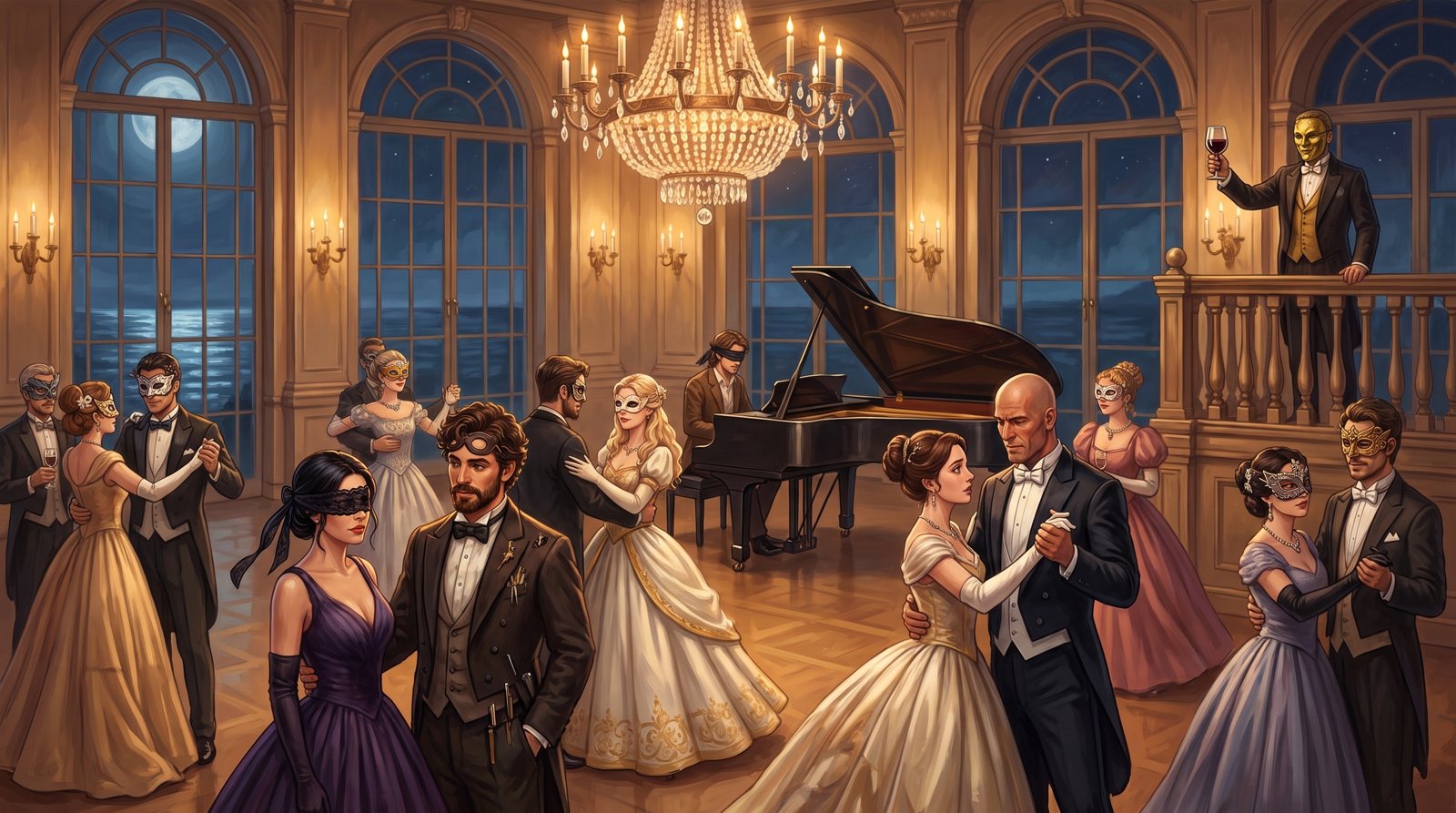 The ball at Castel Notturno | |
| Act | Act 2 (full game, not the prologue); proposed as the act's arc after Where the Day Ends |
| Place | Castel Notturno (working), on the west headland's sea cliff above Pržina, on Island 1's west coast; a cliff road climbs to it from Pržina |
| Length | About 90 minutes on the main line in two visits, plus five side quests (proposal; the brief said 60–90 minutes) |
| Party | All five: the hero, Vella, Stalvan, Manfred, Zanze |
| Villain | Count Aurelio Valsangue (working), a vampire lord; not the Puppeteer |
| Signature | The blindfolded pianist and his waltz |
| Source | The director's Act 2 brief (October 2026), redesigned by the writer (SYN-BALL, 2026-11-17) |
| Status | Planned; the redesign is a proposal, Unconfirmed — awaiting the director |
The story, as you play it
You are the hero of Stara Luka, with four companions: Vella the warlock, Stalvan the sellsword, Manfred the inventor and Zanze, the Keeper of the Library. A letter in black wax asks all five of you to a masked ball.
The invitation. The letter waits at Vella's family villa in Valponte. Count Aurelio Valsangue of Castel Notturno asks "the heroes of Stara Luka" to his autumn ball. Vella's father gets one every autumn and has never gone: "You have to bring a guest. I never had one I could spare."
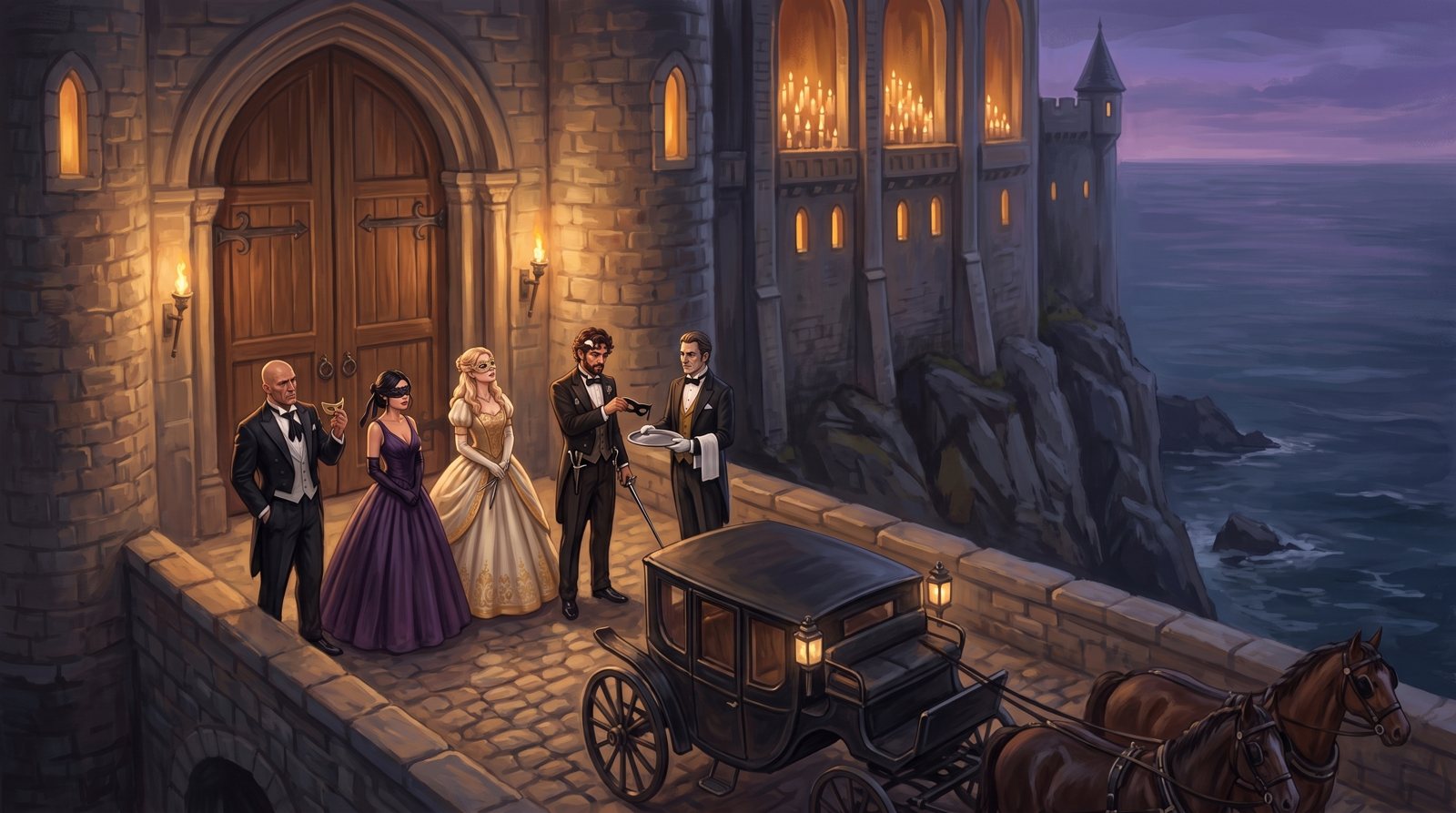
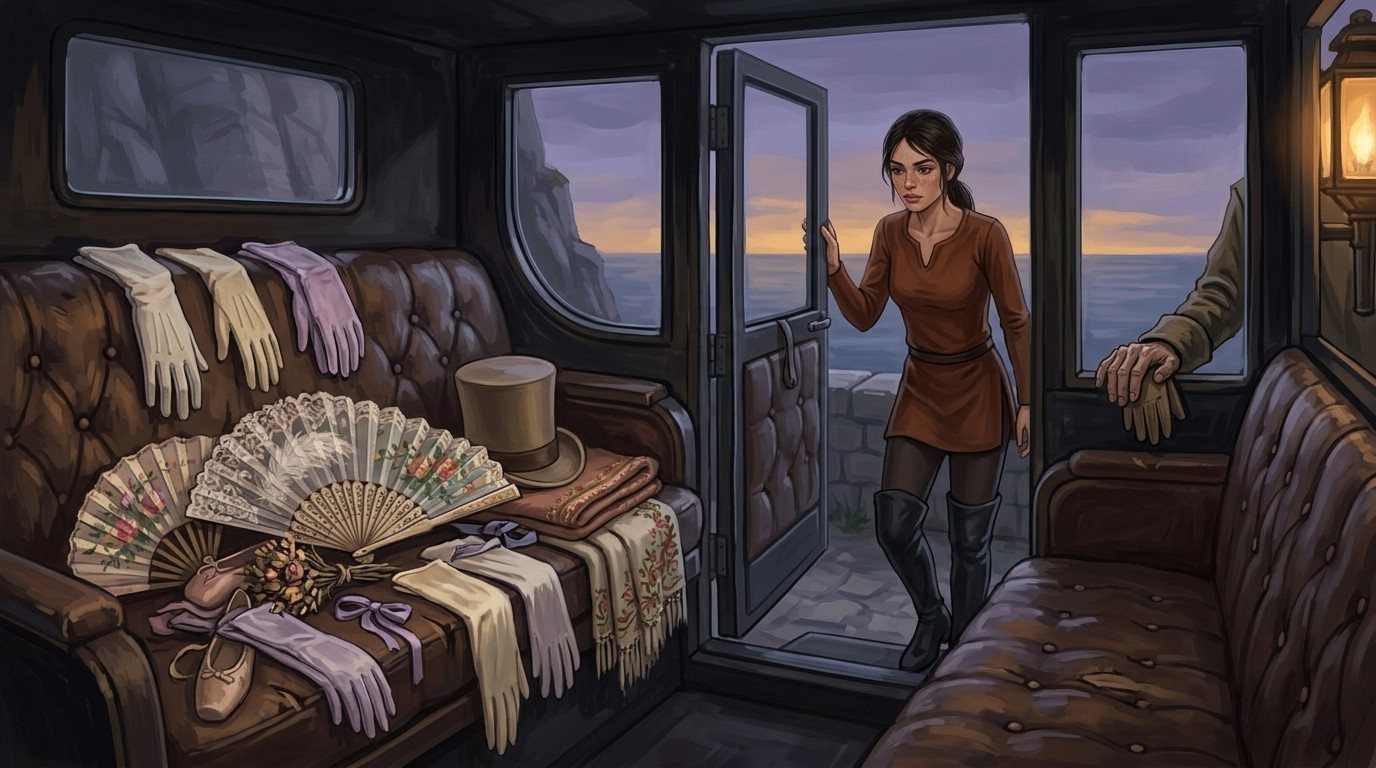
The road up. At dusk a carriage waits in Pržina, the fishing village under the castle's cliff. Inside sits Ser Gaspare Orlić, a warm councillor of Ragosa. The Count asked him to bring you up. At the door Marzio, the majordomo, hands plain half masks to you, Stalvan and Manfred. Vella and Zanze wear their own.
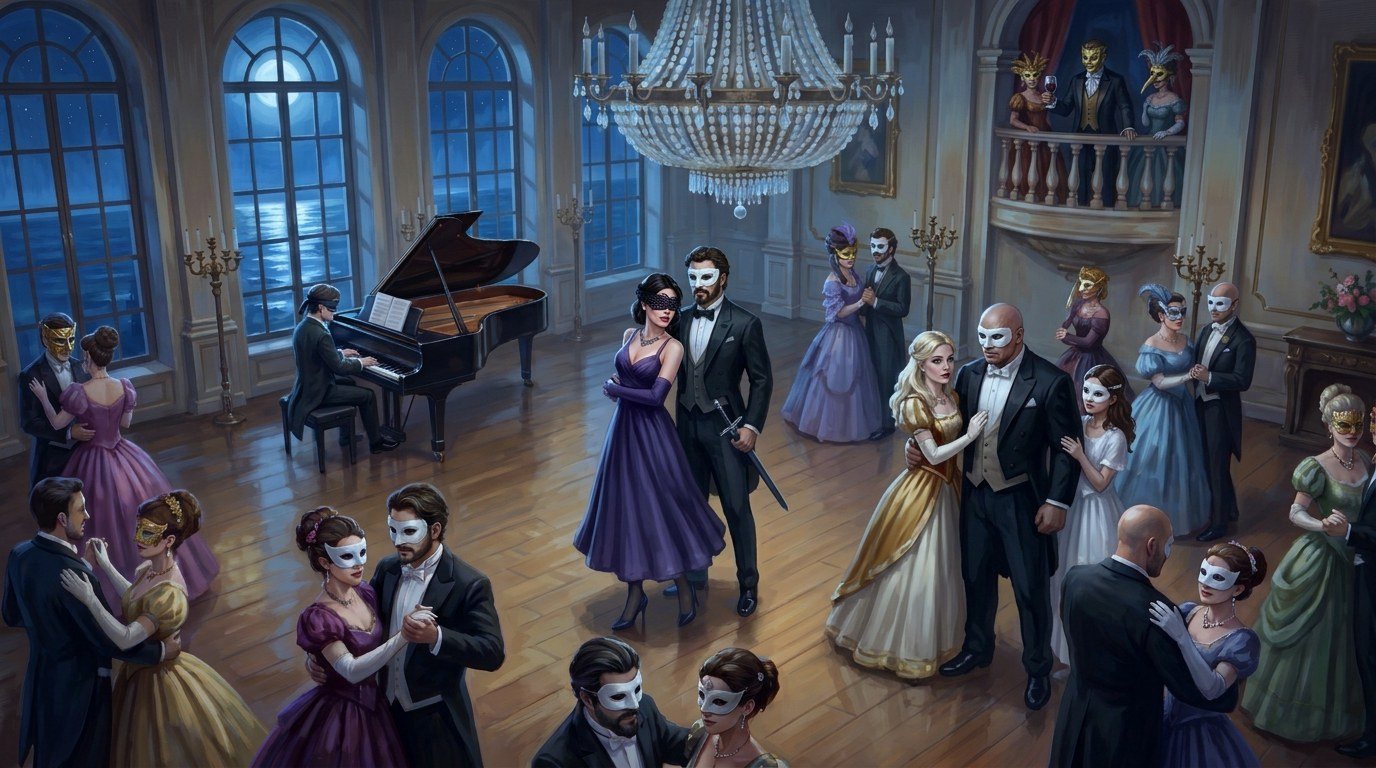
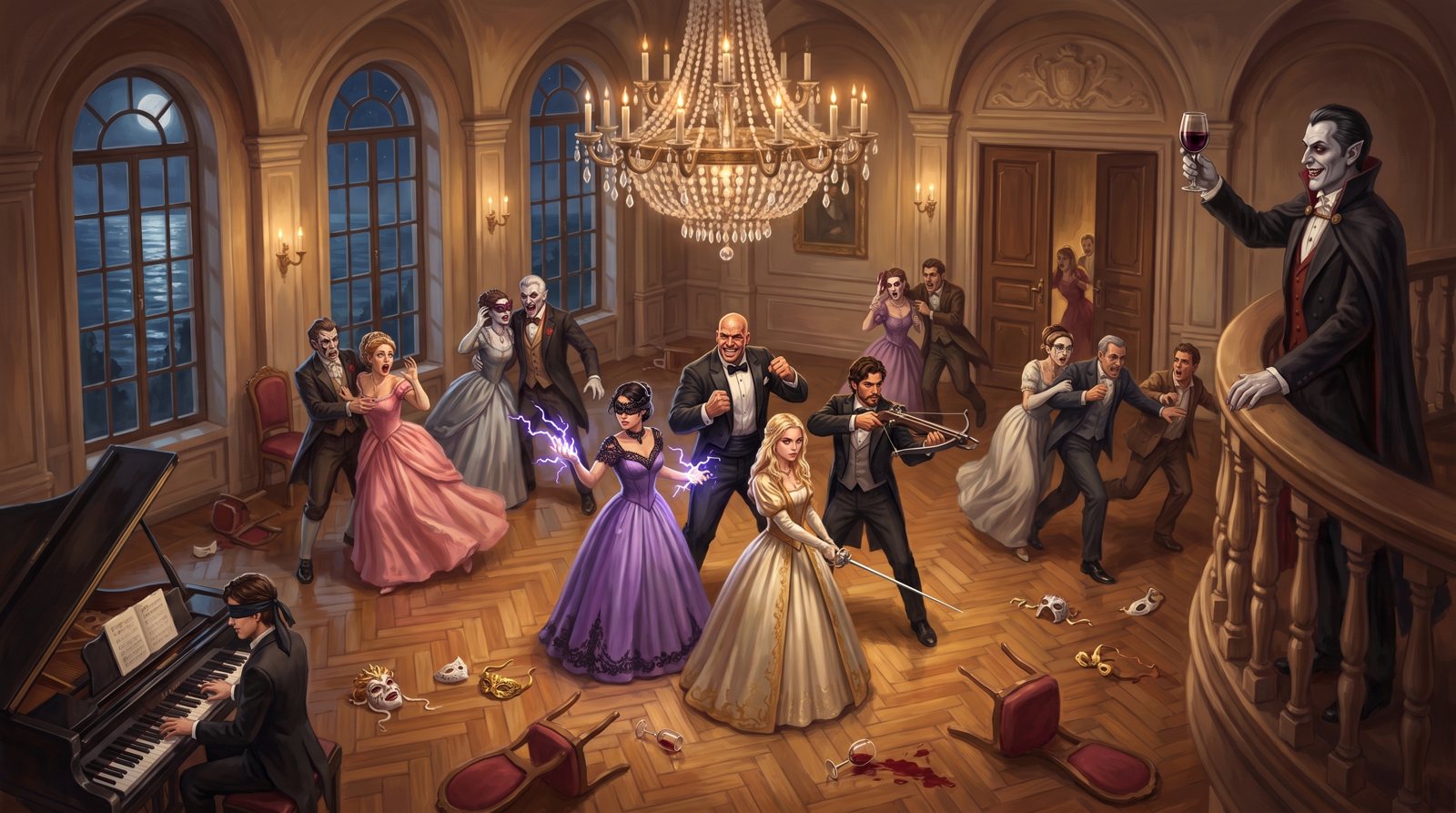
The ball. You meet twelve guests and read the house, each of you by your trade. Seven portraits show the same hands. Every clock is stopped. Lovro, the blindfolded pianist, never pauses. Every plain mask walked in beside a fine one. Vella sees thirty-one dead in plain masks on the great stair. Stalvan finds a hidden door behind the buffet. You can move fine masks onto guests in plain ones, but each mask you take leaves its owner bare.
The dance. The Count comes down in a full gold mask and asks his guests of honour to open the floor. You cannot dance. Vella can. "Where do I look?" you ask. "At the room. That's why we're out here." She teaches you the count of three. Manfred and Zanze turn stiffly beside you, and Stalvan dances well with Mira, a seamstress. The Count waltzes with a lady in a silver mask and speaks to you each time the turn brings the two couples together. The clues you found decide what he admits. Then he asks Vella for eight bars. She comes back quieter: "Cold through the glove. No pulse. He was keeping the piano's."
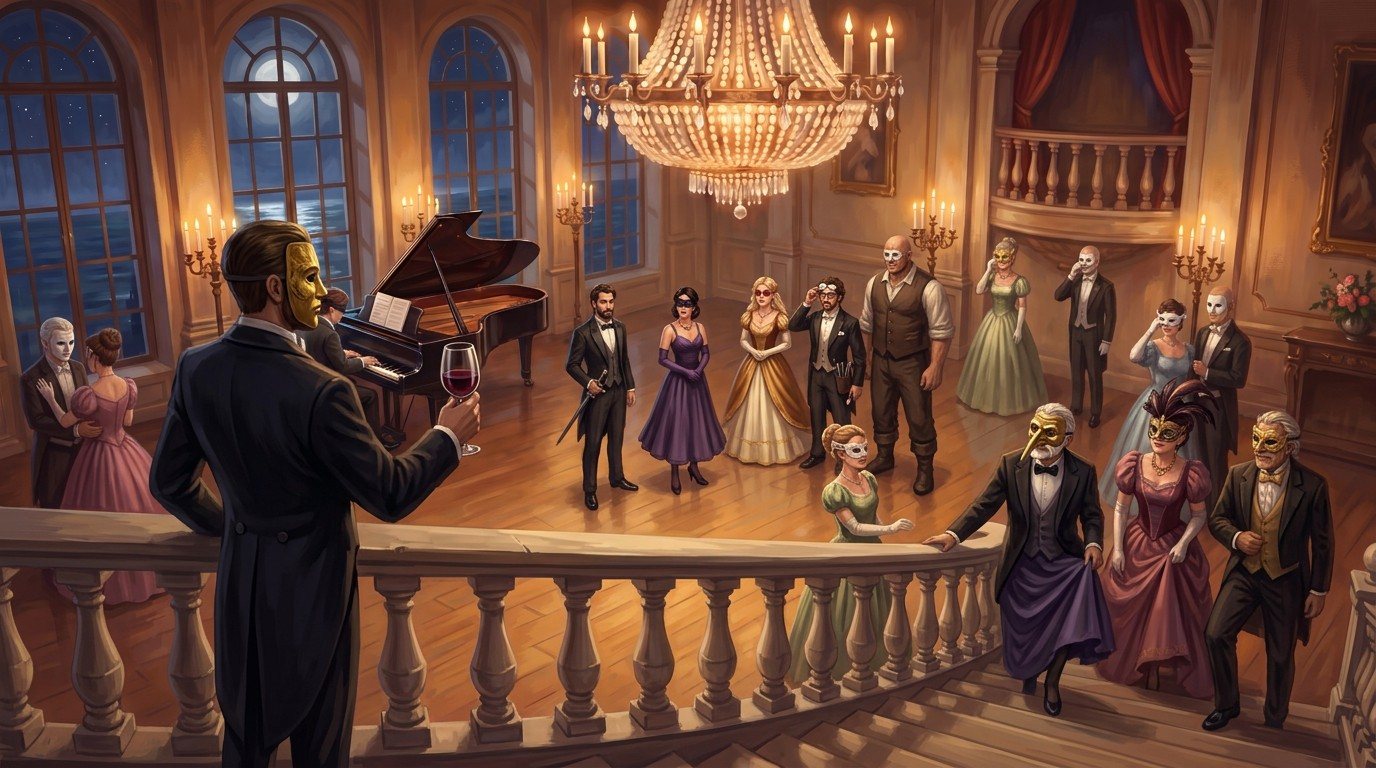
The last chord. The candles have dimmed with the music. The Count raises his glass on the balcony: "Would those who brought someone come up to the balcony." The guests in fine masks climb the stair. Everyone in a plain mask is left on the floor, and the five of you stand among them.
The feeding. The doors are barred. While Lovro plays, the Count's court hunts only plain masks. You guard the piano or get the guests to the cellar door. Then the music stops mid-bar, and everything warm is hunted.
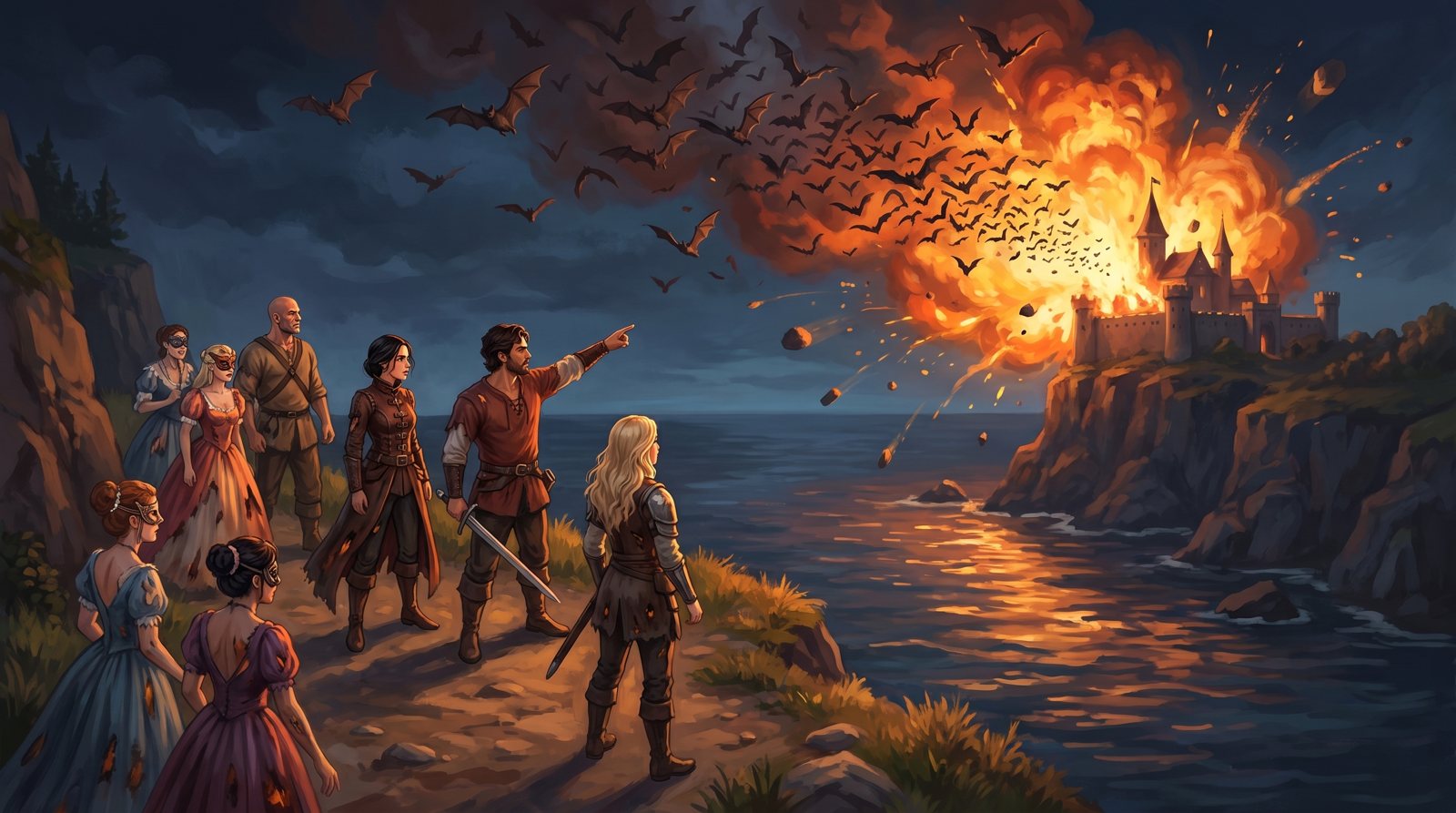
The powder. Under the ballroom lies an old fort's powder store. Manfred needs two minutes, and you hold the stair. The balcony and its guests stand right above the charge. You decide whether to go up for them first. Then the castle goes up over the sea, and a cloud of bats leaves the smoke.
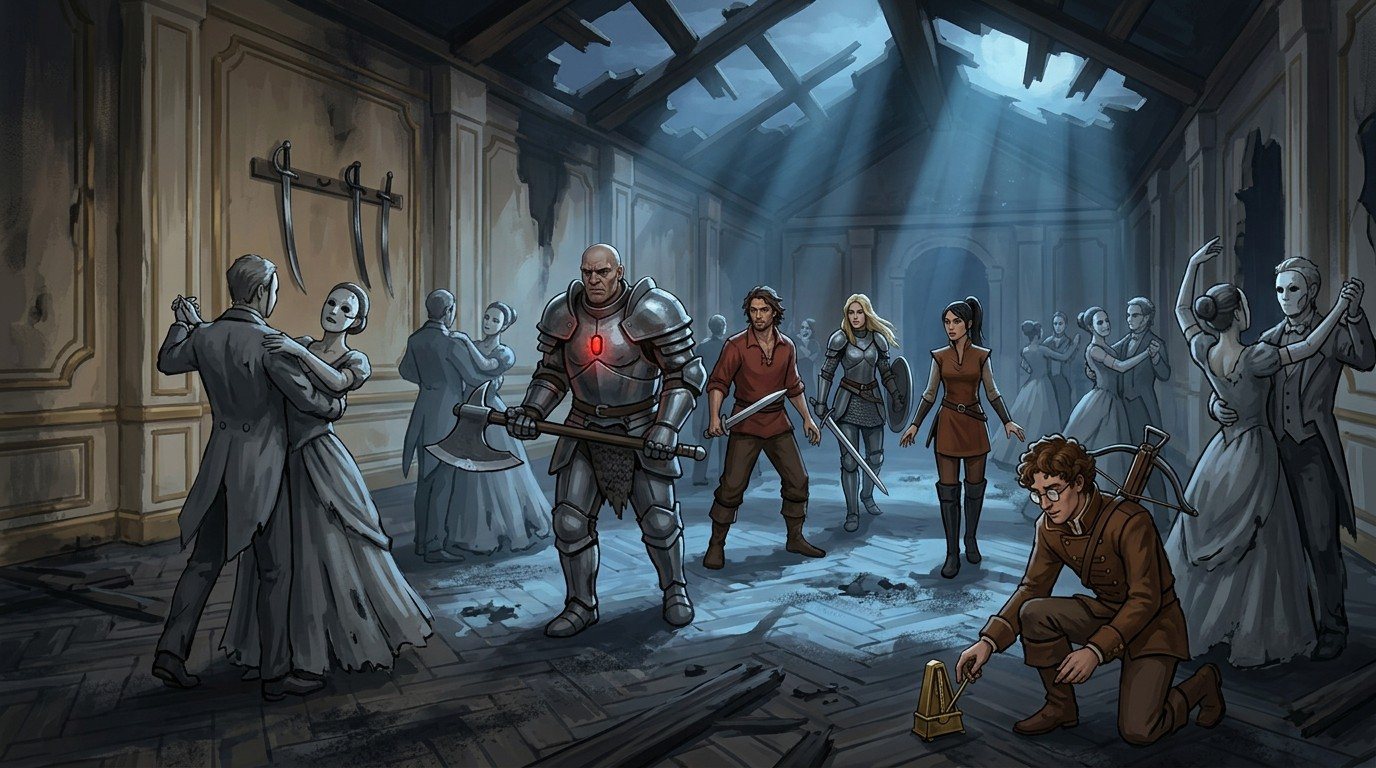
The ruins. In Ragosa people go missing again, and the trail leads back up the cliff. You return at night, in armour. The same waltz plays inside the wreck, slow and out of tune. "They're dancing," says Stalvan. Where the music reaches, the turned sway in place. Where it does not, they hunt. In the roofless ballroom the Count is waiting.
How it ends Spoilers
The ball is a market. For sixty years the island's old houses have bought back their years from the Count, a vampire lord, by bringing him "one more" guest each autumn. The plain mask marks who was brought to be eaten. This year Gaspare brought you. The Count's dead have no pulse of their own and keep time to the nearest music, so silence sets them loose. The lady in the silver mask is Rosana, the girl Gaspare brought thirty-one years ago. She kills the pianist to be free of the music and goes for Gaspare. You decide whether he is worth a fight.
The missing in Ragosa are your mercy's doing. Without the Count's wine the givers you saved grow old by the week, so they carry people up to the ruins to mend him.
In the last fight, The Last Waltz, the Count's heavy blows land on the first beat. Stalvan counts it aloud, and the step Vella taught you keeps the two of you in time when the Count goes for her. If you found the pianist's five burned pages, Zanze gives him his name and he plays his own piece, so the Count loses his time. The Count falls to ash, and the pianist takes off his blindfold for the first time: "Was it a good performance?" "Best I ever heard," says Stalvan. He goes to dust with everything the Count made, and Mira with him if she was bitten. The givers' years come due within the week.
The Masked Ball is the vampire chapter of TLOAA's second act (the full game, never the prologue): two visits to Castel Notturno, a castle of candles on the west headland's sea cliff above Pržina. The first ends with the castle blown sky-high, the second with a last dance in its ruins. The director's brief sets the spine (the castle, the two visits, all five fighting, the Count, the blindfolded pianist and his waltz, the guests to save, the dance, the costumes, the sheet music and Stalvan's moments); the writer's redesign of 2026-11-17 builds the play around it and is a proposal: every change is listed in the design file, so the director can overrule each one. Names marked (working) are placeholders.
The people are on People of Castel Notturno, the quests on Quests of the Masked Ball and the enemies on Enemies of the Masked Ball.
Fixed by the director
The castle on the west headland above Pržina, reached by the cliff road; two visits (the ball ends with the party blowing the castle up, the ruins end with the final boss in the wrecked ballroom); all five fight; the villain is the castle's owner, a vampire lord and the mastermind of the feeding, and not the Puppeteer; the blindfolded pianist who plays the waltz at the ball, dies during it, and plays it again, undead, for the final fight; the guests to save; the dance; the ball costumes; the pianist's sheet music; Stalvan's moments; the music that drives the boss; the ending ("Was it a good performance?" / "Best I ever heard.").
The rules the story keeps
- The borrowed pulse (new lore, proposal). The turned have no pulse of their own and keep time to the nearest rhythm they can hear. While music plays near them they keep its time and can talk, dance and pass for people; in silence they hear only heartbeats, and feed. A sudden change of time makes them stagger. What a maker made goes with him: when the Count dies, everyone he turned stops and goes to dust, the bitten who are still turning too. Thralls, fed on and never turned, go free. Steel, fire and Zanze's oath hurt them; no symbol, water or plant does anything (no real-world religious symbols). This is why the pianist is blindfolded, why the clocks are stopped and why the feeding begins on the last chord.
- The extra chair (new, proposal). For about sixty years the Count's invitation has read "and one more". The old houses of Ragosa and the island each bring one: a poor cousin, a companion, a debtor, a clerk, an unwanted fiancée. The brought wear the plain half masks the majordomo hands out; the givers come in their own fine masks and drink the Count's red, a thick wine cut with his blood that holds back their years.
- Why the heroes. The heroes of Stara Luka now kill the dead, and the Count would rather have them at his table than at his gate. This year he told Ser Gaspare to bring him "something larger".
- Kept apart from the Puppeteer. The Puppeteer's thread moves an empty body; the Count's turned keep their minds and their hunger. The Count calls the threads vulgar.
Part 1: The Masked Ball
The invitation
The letter in black wax, "for the heroes of Stara Luka", waits at the Castellani villa when the party comes down from the dark west. It asks them to the Count's autumn ball and promises that "dress will be found". "Guests of honor," says Vella. "That's either flattering or a menu." "There's always food at these things," says Zanze. "The question is for whom." Vella's father has been invited every autumn and never went: "You have to bring a guest. I never had one I could spare." (A proposal that uses Vella's family.) Zanze notices that their letter asks for no guest, and that someone already knows their sizes.
Pržina and the cliff road
At Pržina's gravel cove the coachman Nane waits on the box; the party can talk him into waiting at the gate past midnight (a roll), and if he does, his carriage is at the cliff lookout when they come out. Inside sits Ser Gaspare Orlić, a councillor of Ragosa, delighted: "Thirty-one autumns I've ridden this road. You'll love the music." If the party showed Ragosa its Keeper's bones (The Keeper of Ragosa, choice A or C), he adds: "You've cost me a dragon. I've decided to forgive you."
The door and the ball
The majordomo, Marzio, hands plain half masks to the hero, Stalvan and Manfred; Vella and Zanze wear their own, and Gaspare his gilded one. The party's weapons go in on their bodies, as always: "Ceremonial, of course."
The ball is played: no fighting, only twelve guests to meet and a house to read. A guest book fills in as the party learns who is who. The clues are read by trade, with Insight or Perception, the player choosing the roller (a failed roll still gives a weaker version):
- Zanze, at the portraits: seven counts in two hundred years, the same hands, the same ring on the same wrong finger.
- Manfred: every clock in the house stopped at the same minute, the pendulums tied with ribbon. Nothing keeps time but the piano.
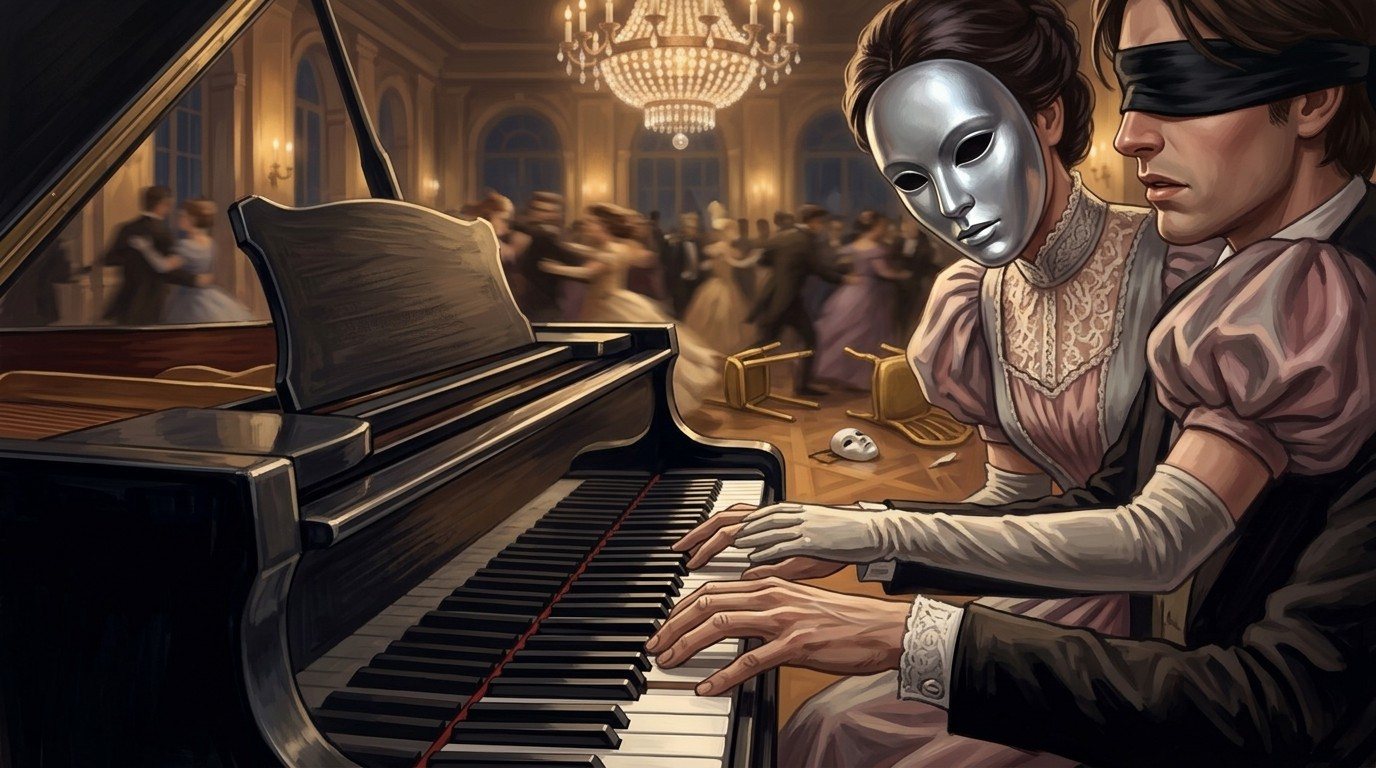
- The hero, at the piano: asked for something of his own, the pianist plays four bars in four time, the courtiers falter, and the majordomo hurries over: "The Count's waltz, maestro, please." In the pause Zanze feels it: "Half the people in this room have no heartbeat."
- Stalvan: every plain mask in the room walked in beside a fine one. "Ours walked in beside the councillor."
- Vella: the thick red is poured only for the old guests in fine masks, and the hosts never drink.
- A maid with a bandaged neck, Nela: "Don't let him stop playing." She shows the servants' stair.
- Vella's sight: thirty-one dead in plain masks stand on the great stair, looking up at the balcony. Zanze names it, as her page says she would: "There's an old word for it in our books. Grave-sight. You see the ones who haven't gone on." "Lucky me."
At the buffet Stalvan says what he sees: "So much food, and nobody's eating." "The hosts aren't hungry for that," says Vella. Behind the buffet the wall breathes; Stalvan finds a hidden door, and below it the old fort's powder magazine, kept dry. (If the party has been through Ragosa's Bone Gallery, Manfred adds: "Brne would have wasted half of this.") If the party sold the Gull mask in the dark west, a courtier is wearing it: "That's Matija's gull."
Moving the masks is the ball's decision. A fine mask on one of the brought makes the courtiers pass her by while the music plays. Vella and Zanze can give their own and take plain ones; the Count's locked mask room holds two more; and three givers can be talked out of theirs, each of whom is then hunted in their place.
The dance
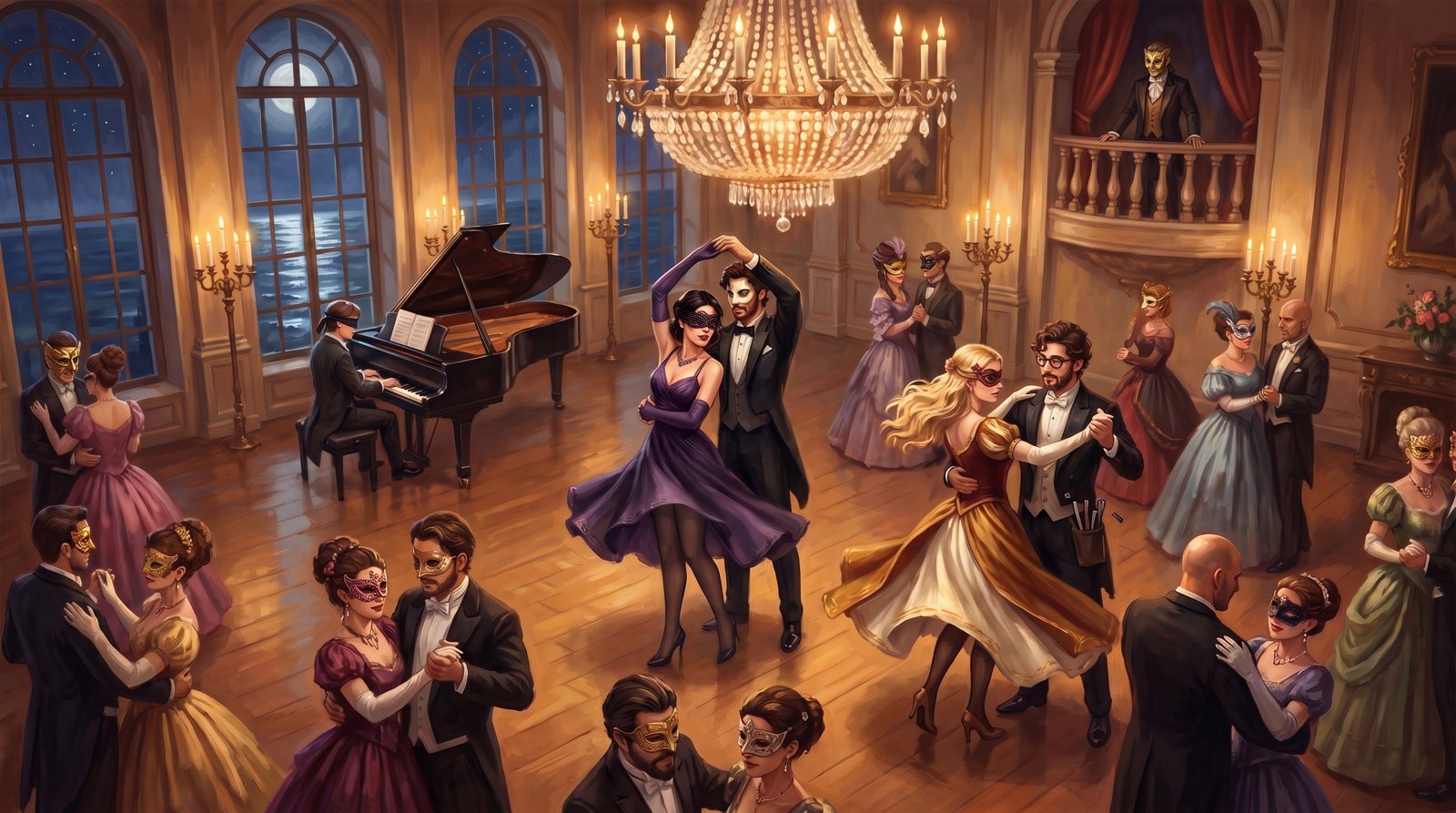
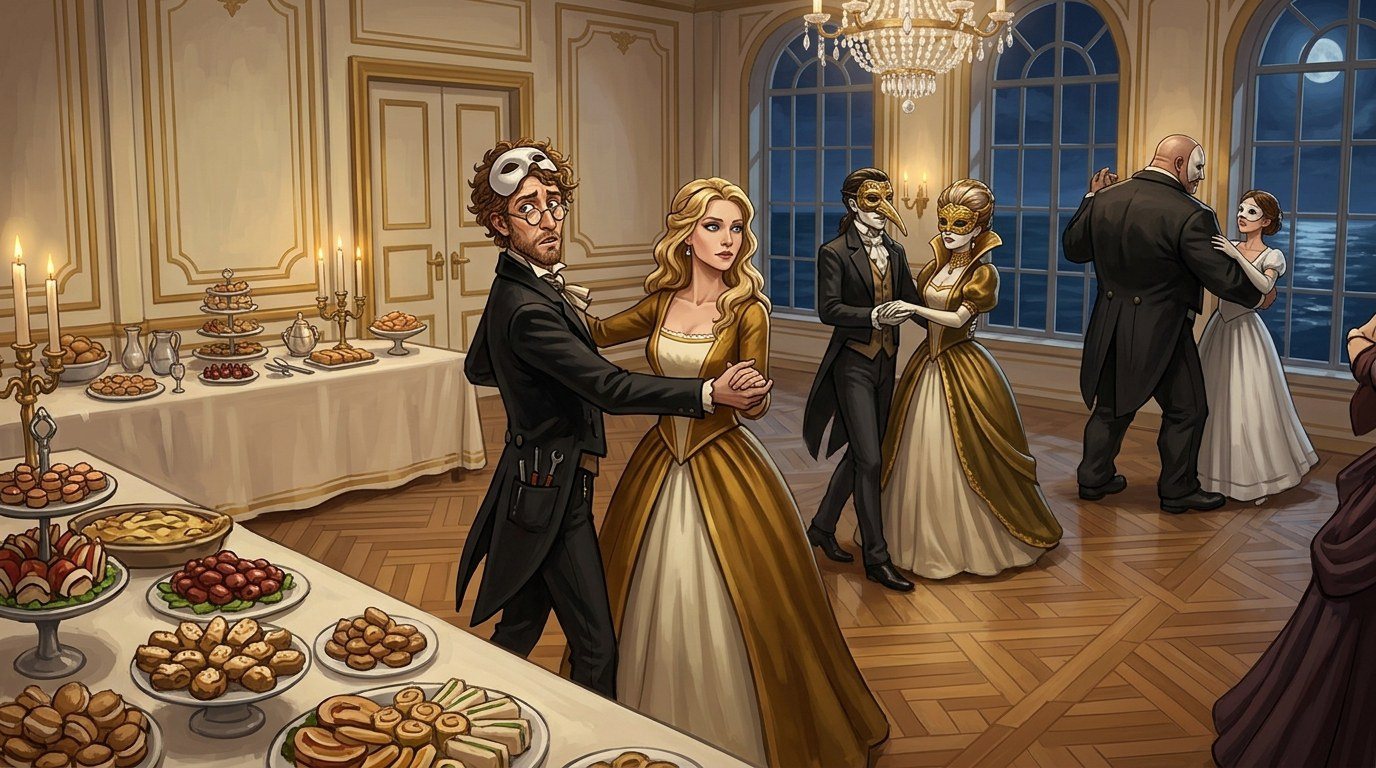
The Count comes down, gives his hand to a lady of his court in a silver mask, and asks his guests of honour to open the floor: "Madonna Castellani knows the way." The dance is played, and the couple the player dances is the hero and Vella. Every couple on the floor is a man and a woman: Manfred turns with Zanze along the buffet wall, Stalvan with Mira by the windows, and the courtiers ask the plain masks up one by one.
The step. The hero cannot dance, and Vella grew up in rooms like this. "I can't dance." "I can. Hand here. Don't look at your feet." "Where do I look?" "At the room. That's why we're out here." She gives him the count: "One is the long step. Two and three are small. Count if you have to." A pale ring pulses on the floor on every first beat. Nothing is asked of the player here; the ring comes back in the last fight.
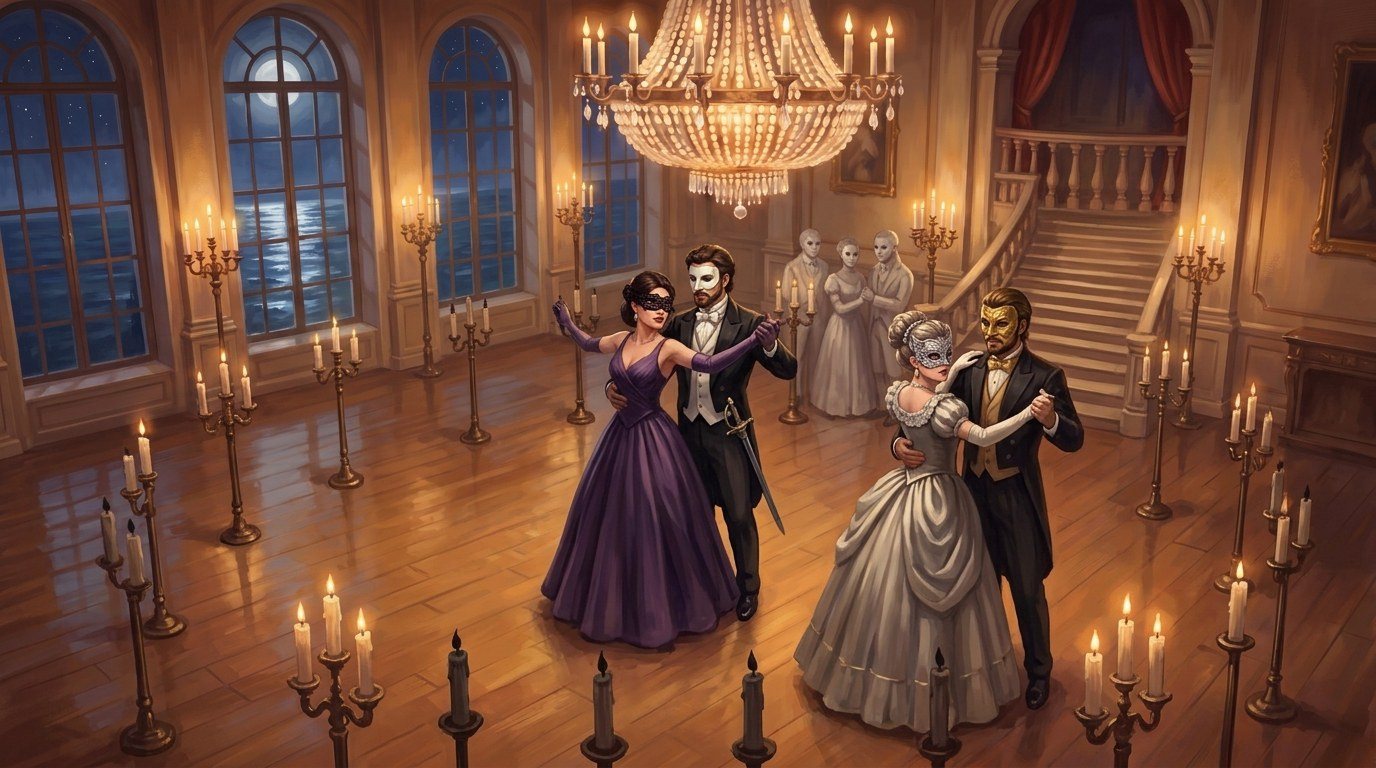
Three passes. The Count and his partner circle the other way, and once in every turn of the room he sets his step beside the hero's and speaks. Three passes carry his three turns of talk. "Someone on this island has been walking the dead about on strings. Vulgar. My guests climb my road on their own feet." The hero's replies, opened by the clues, make him admit who brought them (Ser Gaspare, after thirty-one autumns of bringing someone) and why: "Every house in Ragosa is fed by someone who isn't at the table. I'm the only host honest enough to set the place." He has a word for the lamp next door ("You put out my neighbour's lamp. I had grown fond of the dark next door.") and, if Ragosa lost its dragon, for that too. If the hero says nothing: "You dance like a man counting exits. The lady dances as if she had found them." Between the passes Vella reads the other couple: "Watch his feet. He isn't leading her. The piano leads them both." The lady in the silver mask says one thing as she turns away: "He counts aloud. So did I, my first autumn."
Manfred and Zanze. "I build things that turn. I'm not one of them." "You're wrong at a steady speed. I can work with that." He steers them toward the buffet door, slowly. She tells him to go by the wall: "The couple that just brushed us had nothing in them." "Nothing?" "No heartbeat. Either of them. Keep turning."
The eight bars. On the third pass the Count stops beside them. The lady in the silver mask walks to the piano and stands behind the pianist. "Madonna. Your father refuses me every autumn. Give me eight bars." Vella nods, and the hero waits at the floor's edge. "You keep looking at my stair, madonna. Most guests look at the chandelier." "Most guests can't count to thirty-one." "Listen. He's coming to the end." He lets go, bows and climbs to the balcony. Vella comes back quieter: "Cold through the glove. No pulse. He was keeping the piano's." "And when the piano stops?" "Then he hears ours."
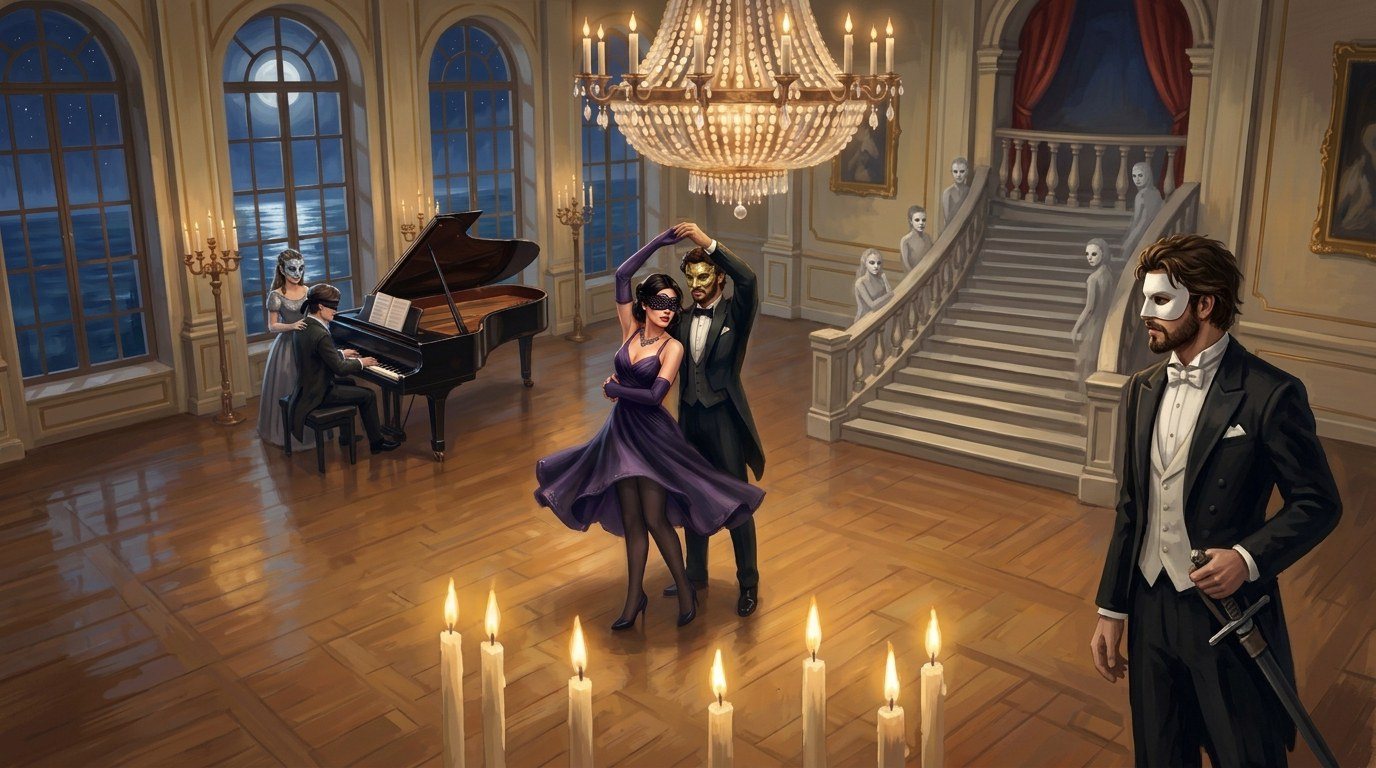
The candles dim one by one in time with the music. Stalvan dances with Mira, the seamstress who made the party's clothes, and is surprisingly good: "Ipu taught me. Between the ovens. I count to three. Every time."
When the last chord comes, the hero and Vella are at the centre, nearest the piano; Manfred and Zanze are at the buffet door; Stalvan and Mira are by the windows. All five stand on the floor among the plain masks. On the last chord the Count raises his glass: "Thank you. Would those who brought someone come up to the balcony." The givers climb the stair without looking back, Gaspare last; the brought are left on the floor. "Thank you all for coming," says the Count. "Now... dinner." The pianist lifts his hands. Four seconds of silence, and the courtiers' masks come off. "So the small mask wasn't a mistake," says Stalvan. "No," says Vella. "It's a place card." If Mira wears a plain mask, a courtier is on her before the line ends; Stalvan tears him off, and she lives, bitten.
The feeding
The doors are barred: no one leaves before the last dance. The way out is the cellar door behind the buffet. The feeding has two movements:
- The music. The pianist starts again, sure it is theatre, and while he plays the brood keeps its manners and hunts only plain masks, the hero, Stalvan and Manfred first. The party chooses between guarding the piano, which keeps the music going longer, and fetching the guests. From the balcony, as it begins: "Do keep fighting. It thins the blood beautifully." And later: "Please, go on. Nobody has fought for these people in thirty years."
- The silence. Rosana, the Silver Mask, mist-steps to the piano, and the music stops in the middle of a bar. "Rosana. That was rude," says the Count. Now everything warm is food, the fine masks too. Rosana goes for Gaspare, the man who brought her at nineteen; the party can fight her and save him, or let her take him.
Blowing the castle
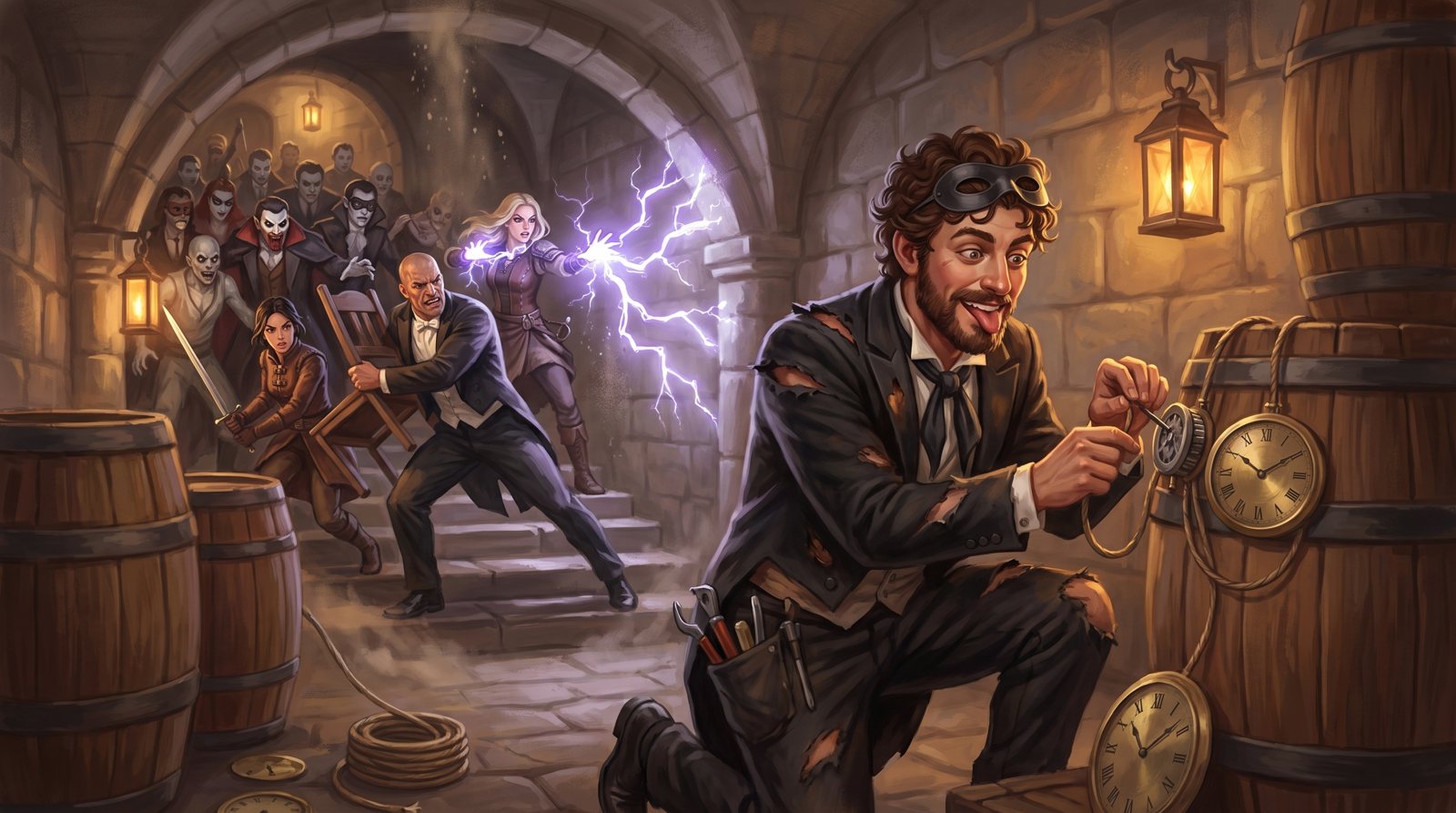
"It's an old sea fort. The magazine's right under us. Give me two minutes." The party holds the cellar stair while Manfred sets the charge. Halfway through he tells them that the balcony, where the givers are, sits right above the magazine. The hero decides: light it, or go up for them first while three hold the stair alone. Then comes the run, through the magazine and the fort's sea gate and along the shelf path on the cliff face to the lookout, with the survivors.
Between the visits
In Ragosa the saved thank the party and some reward them; the families of the lost ask what happened, and the party tells them the truth or a lie. Then people go missing again, from the lower town and the refugee camp, and lights are seen in the ruins at night. A saved guest saw a carriage leave by the land gate at midnight with someone in it; the party watches the gate, tails the carriage up the cliff road unseen, and at the cliff lookout sees which saved giver hands his passenger over: without the Count's wine the givers' years are coming back, and the people the party saved have been carrying people up to the ruins so that he can mend. Ser Ruggero, the wine merchant who wanted out, brings the crypt key; if he died, the coachman Nane has a copy.
Part 2: The Ruins
The same cliff road, now at night: the castle is a blackened shell over the glittering sea, and from inside comes the same waltz, slower, out of tune, with notes missing. "Someone's playing," says Stalvan. "Someone who shouldn't be," says Zanze. "He's dead. I heard him stop," says Vella.
Where the waltz can be heard, the turned sway in place, in time ("They're dancing."); in the deaf corners they hunt. Manfred's metronome, built from a clock's movement he took at the ball, ticks in four and makes them stagger. The way leads through the collapsed entrance hall (the lost guests, now ferals, each health bar showing a name), the flooded magazine, the crypt (the majordomo, turned at last, guards the coffins; sixty years of guest books; the newly missing in the cells), and the burned portrait gallery (the old fort's garrison in black armour, and a saved councillor met on the stair with someone by the arm), to the ballroom. Five burned pages of the pianist's music lie hidden on the way, their margins telling his story; the last is signed Lovro.
The Last Waltz
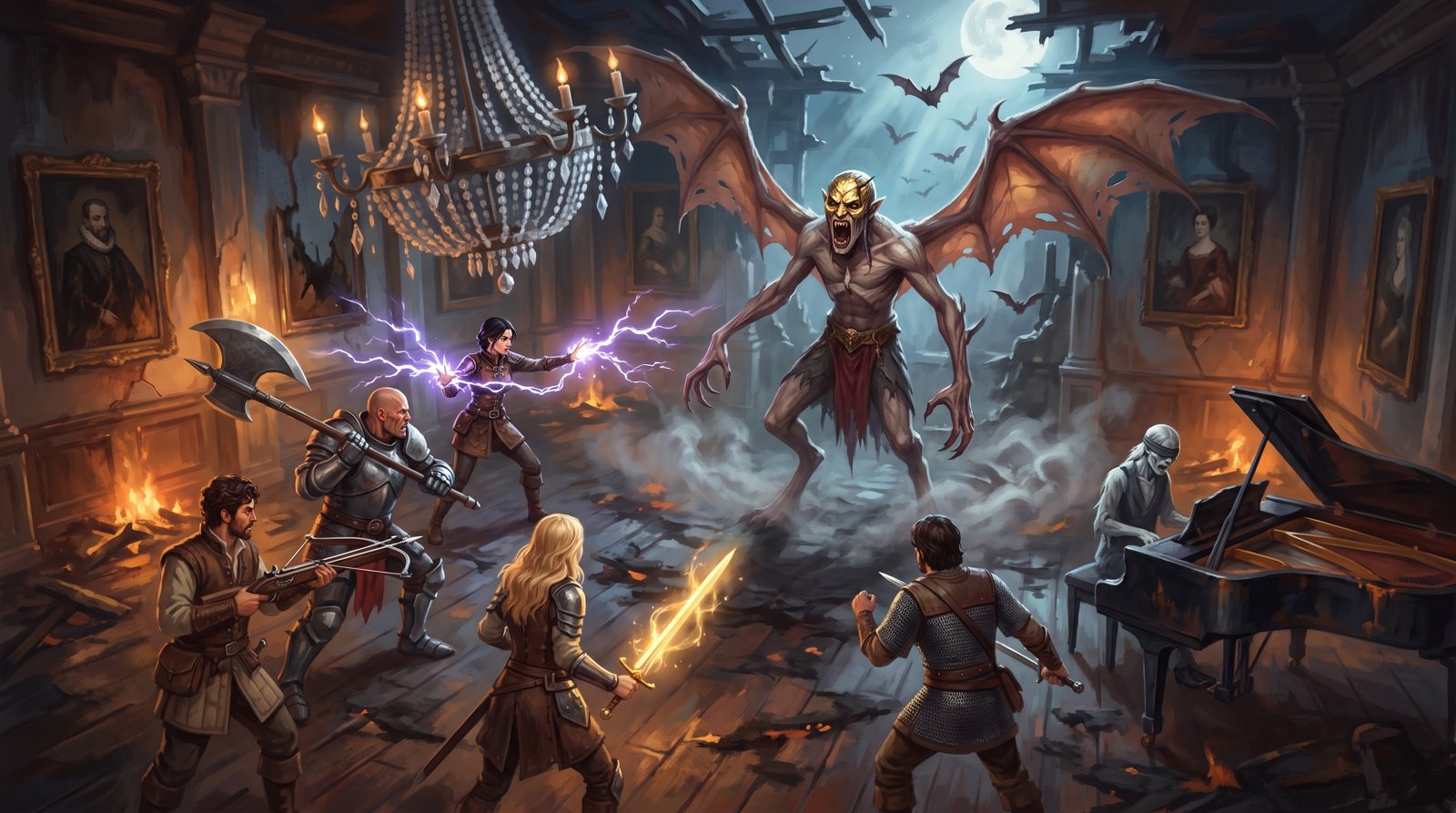
Vella starts to warn them ("Careful. He's faster than he looks. If we split up, he'll—"); Stalvan is already charging, and says the first beat aloud: "One." He counts every heavy strike for the party from then on. The dance at the ball comes back twice. The Count learned there that Vella sees his dead, so his first mist-step in each phase goes to her: "Madonna. Are they still on my stair?" And the hero learned the count from her: while the two stand close, each sees the ring under the Count's next heavy strike one beat early (In step; numbers Unconfirmed). "One is the long step." "I remember."
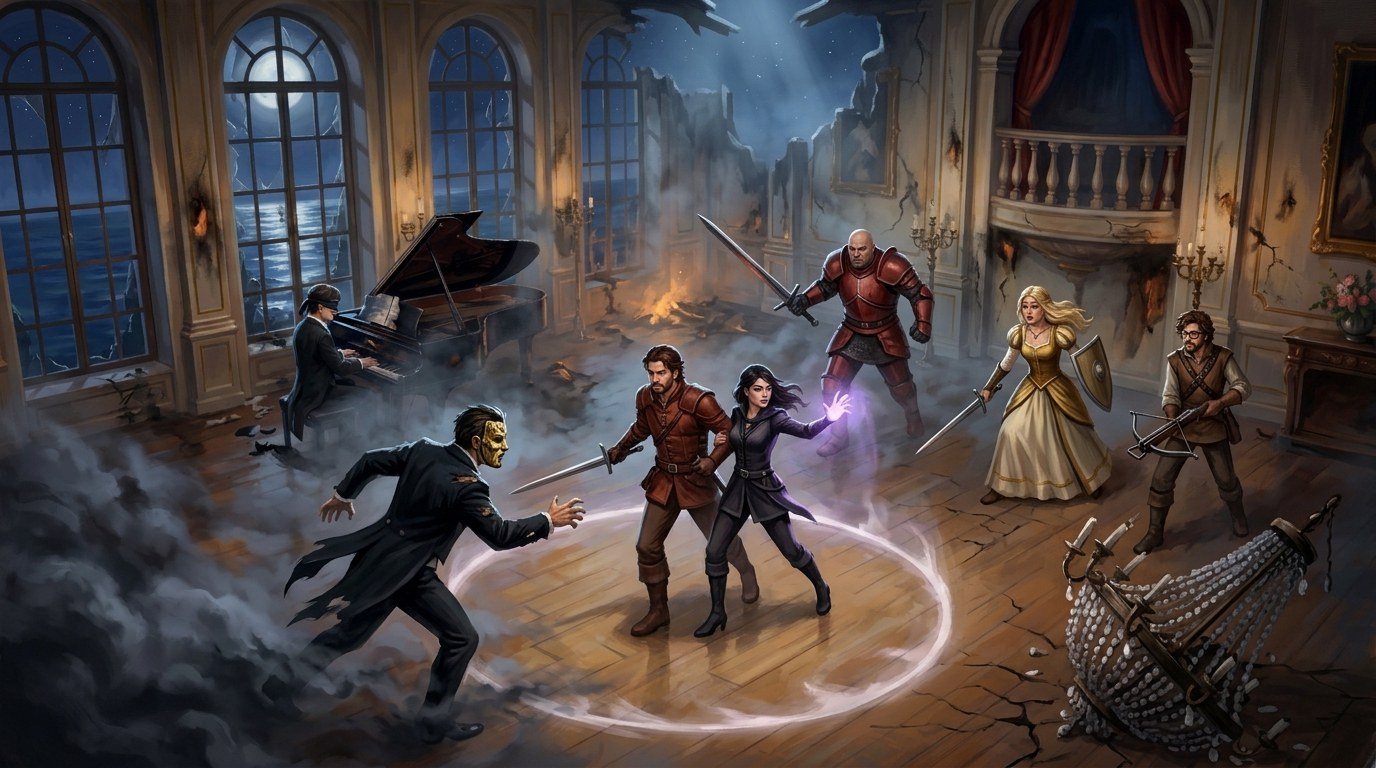
The fight has the brief's three phases: a duel of lunges, mist-steps and life-stealing blows; a banquet in which the Count drains his own thralls to heal while bats circle; and his true form (long limbs, ragged wings of skin, a jaw that opens too wide) as the pianist plays frantically. With the five pages Zanze can reach the piano and give the pianist his name: "Lovro. We found your pages. Play the one you wrote for Anica." He stops the Count's waltz and plays his own piece, and the Count loses his time.
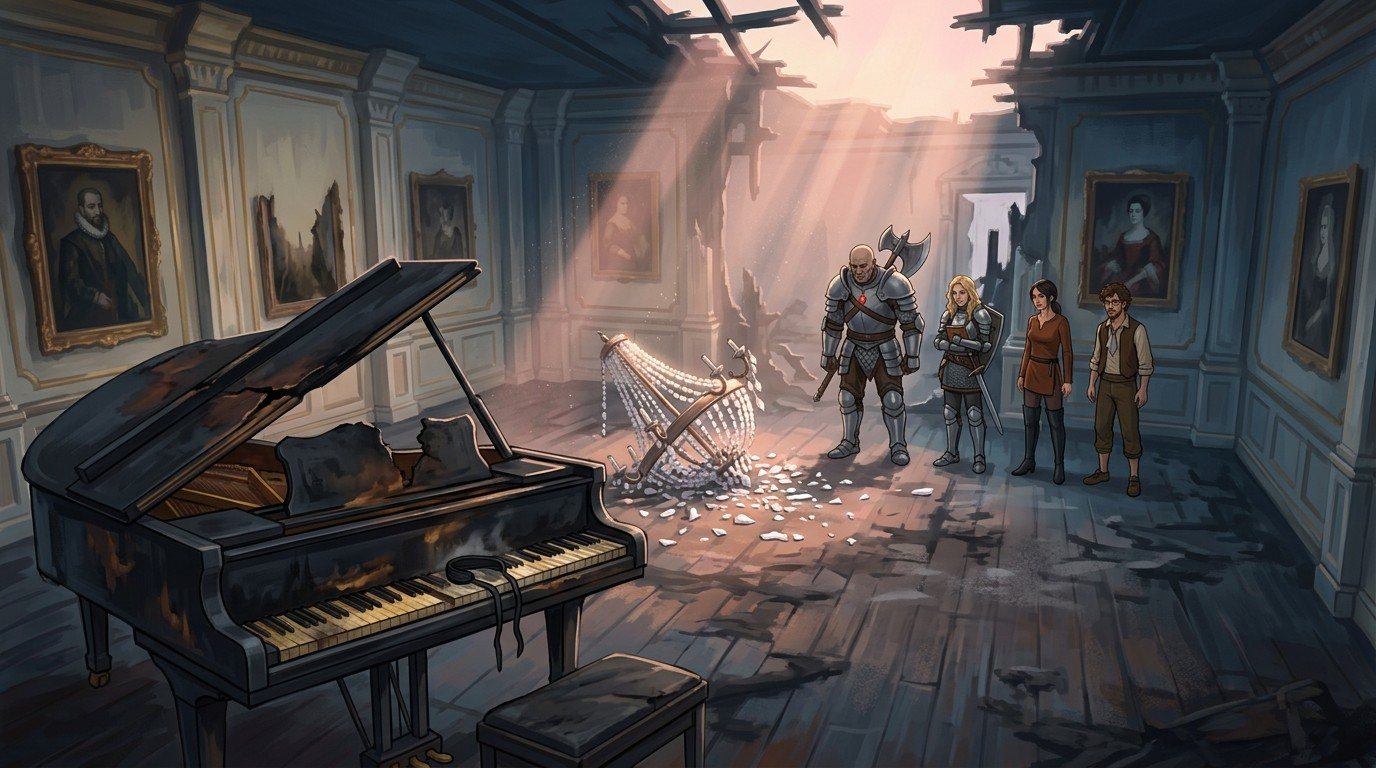
When the Count falls to ash, the music slows and stops. The pianist removes his blindfold for the first time and looks out at the ruined ballroom. "Was it a good performance?" "Best I ever heard," says Stalvan. He smiles and goes to dust with everything the Count made; with the pages, Zanze says quietly, "Rest now, Lovro." Vella looks at the stair: "They've gone." The picture holds on dawn through the broken roof and a blindfold on the keys.
What it costs and changes
- The pianist goes with his master, as every turned one does.
- Mira, if she was bitten at the ball, dies the same night in Ragosa; Stalvan sits by an empty bed: "She kept time better than me." A fine mask at the ball would have kept her.
- The givers' years come due within the week.
- The custom of the extra chair is over; its sixty years of names are in Zanze's hands.
- Nane drives down the cliff road with an empty carriage.
- In Pržina the pianist's sister keeps his pages, and the fishermen whistle the waltz.
Choices that matter
- The masks (the ball): who gets a fine mask, and which giver loses one.
- Rosana and Gaspare (the feeding): fight for the man who sold the party, or let his first gift have him.
- The balcony (the hold): light the charge, or go up for the givers first.
- Guests saved (0–12): rewards in Ragosa; every lost gift returns in the ruins as a feral with a name; every saved giver may feed the Count between the visits.
- The giver on the stair (the ruins): what to do with a saved guest caught bringing someone.
- Sheet music pages (0–5): the pianist's name, a unique reward, the last waltz changed, one extra line at the end.
Stalvan at the ball
His lines from this arc are collected with the others on Stalvan's jokes. The redesign keeps the mask, the buffet, the dance, the explosion, the charge and "Best I ever heard", and drops the brief's two hunger lines, "Will there be food?" and "Finally, food." (user, 2026-11-08: Stalvan is never the butt of hunger jokes).
Open decisions
Unconfirmed — awaiting the director: the whole redesign (the borrowed pulse, the extra chair, the played ball and dance, the two movements, the balcony, the givers feeding the Count, Mira's cost); the names (Castel Notturno kept; Count Aurelio Valsangue kept from the brief; the pianist Lovro proposed for the brief's Luka, which is already Stara Luka's stable boy); the Count's link to the Puppeteer (recommended: none, one line of echo); lost guests as named ferals (recommended: yes); the Count's true form; the sheet-music reward (proposed: Lovro's Band); Act 2 levels and enemy stats; the order of Act 2's arcs.
See also
- Castel Notturno · People of Castel Notturno · Quests of the Masked Ball · Enemies of the Masked Ball
- Where the Day Ends, the dark west next door, before the ball · Under the Green Crown, Act 2's first arc · The Keeper of Ragosa, Act 2's second arc · The Puppeteer · Vella
- The Prologue · Stalvan's jokes · Island 1 · Portal: Lore
Sources: plan - act 2 masked ball.md (the director, 2026-10-08); docs/plan/full_game/act2_masked_ball.md (SYN-BALL, 2026-11-17, the redesign and every departure from the brief); references/concept/act2_masked_ball/; docs/decisions.md (2026-10-22 14:08; D-WIKI-SYN-1); docs/towns/world/world_map.html (Island 1).
Last updated: 2026-11-18 (BALL-DANCE-1: the dance is the hero with Vella and Manfred with Zanze; the Count speaks at three passes and takes eight bars with Vella; the opening block rewritten as the story as you play it)
Categories: Lore & History · Story · Full game (proposal)