The missing mayor
↓ Download PDF print-ready character dossier| The missing mayor | |
|---|---|
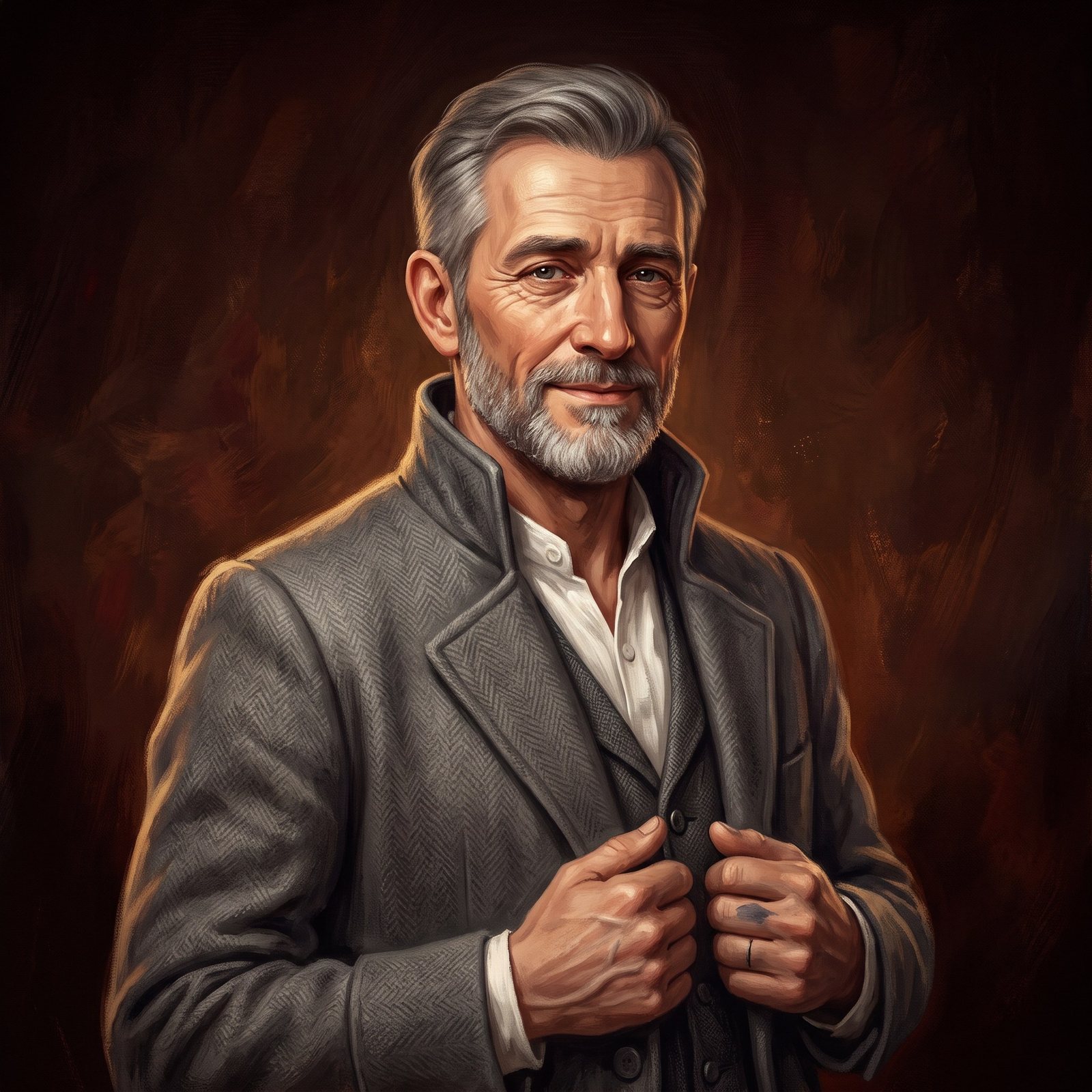 Ser Filip, notary and mayor of Stara Luka (concept portrait) | |
| Name | Ser Filip (working) |
| Type | NPC; never seen in the Prologue, met in the final act |
| Role | Mayor of Stara Luka, and its notary before that; the party's employer |
| Family | Dora, his wife, the town's midwife, and Mila, his daughter, aged seven (both died in the fever winter, two winters before the game) (working names) |
| Horse | Bura, a grey mare with white socks (working) |
| Last seen | Everywhere, and never twice on the same day |
| Secret | Yes: see Beyond the prologue below (spoilers) |
| Status | Story design (STORY-QUESTS-1, 2026-10-25; STORY-MAYOR-2 and STORY-MAYOR-3, 2026-10-26) |
The mayor of Stara Luka (Ser Filip, working name) is the man whose contract brings the party to the town, and who is never there to meet them. He is gone before the story begins, and every chapter of the Prologue finds his trail: a riderless horse, a letter, a grey coat seen a day too early or a day too late. The Prologue never says what happened to him. It leaves three readings open (victim, accomplice or culprit), and every clue fits at least two of them.
This page is spoiler-free down to its last part. What happens after the prologue is told in full below, spoilers included (Beyond the prologue).
Summary
- About sixty: gentle, precise, generous, admired, with a lovely hand at letters. People in Stara Luka speak well of him, and they all speak of him a little sadly.
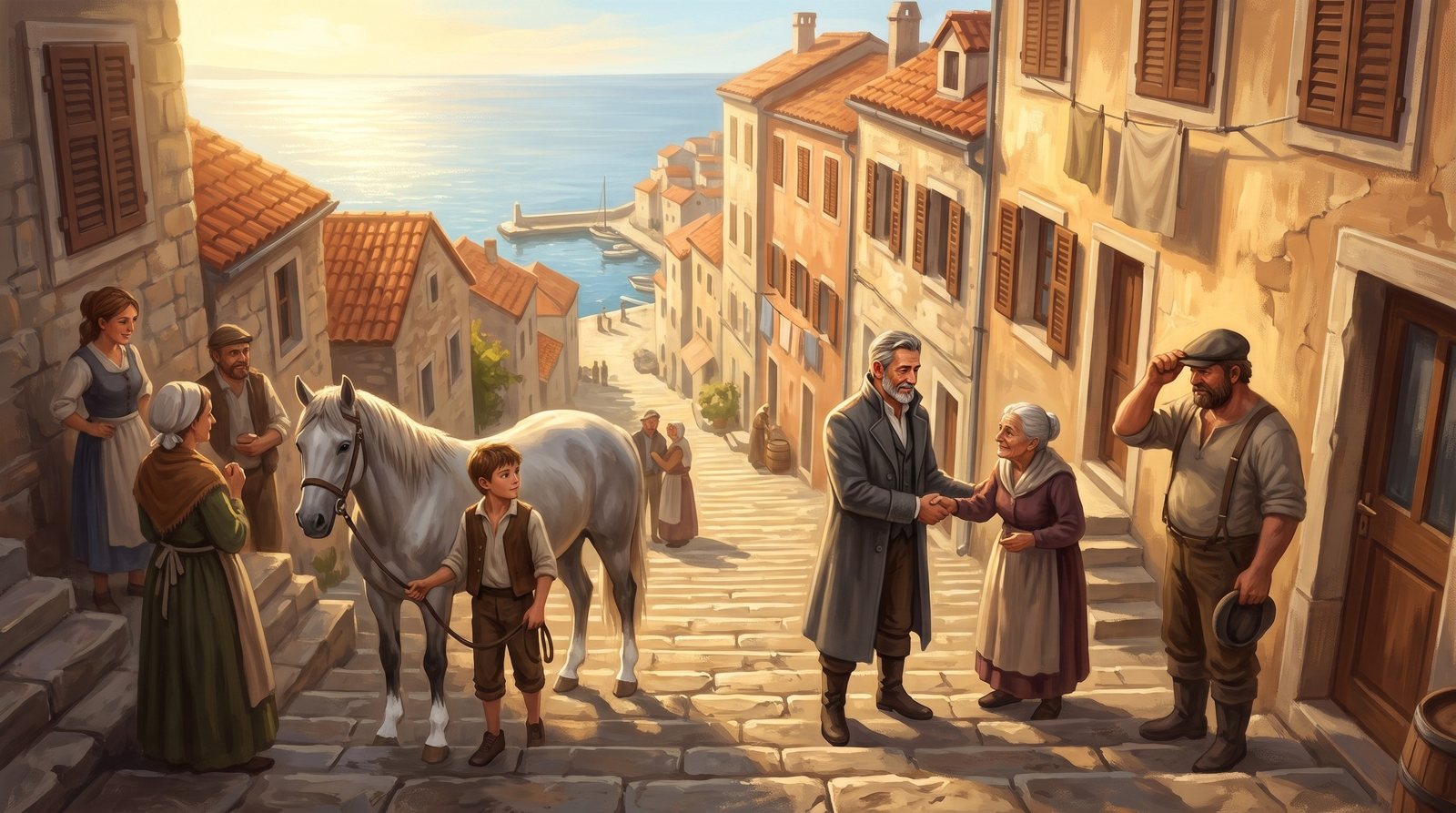
- Before he was mayor he was the town's notary. Ser is a notary's title, not a knight's: he wrote half the town's wills, its marriage contracts and every contract it signed, the party's own among them. A rope-maker's son, he was the first mayor not from one of the old fishing families.
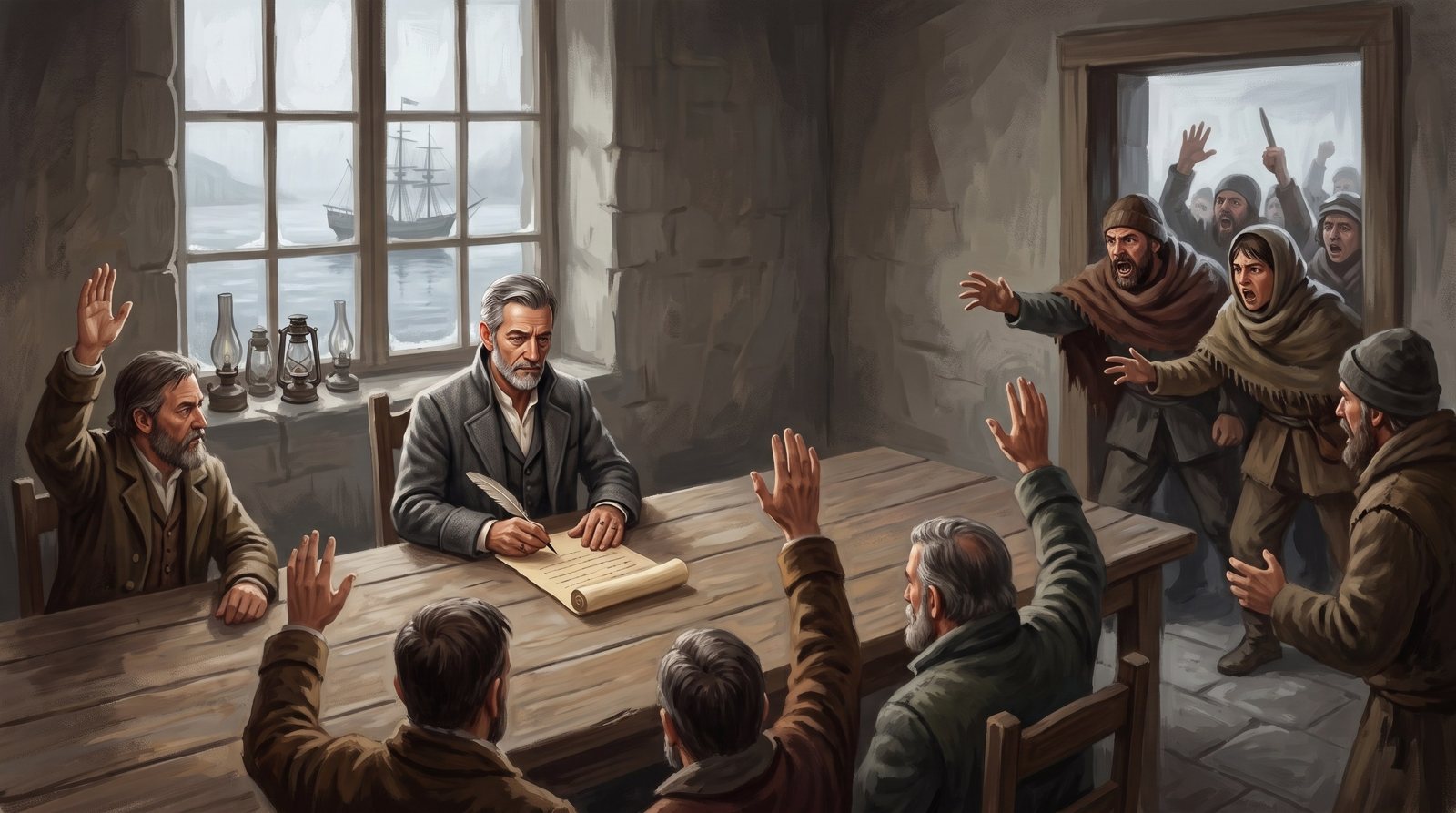
- The fever winter. Two winters ago a grain ship with sick men aboard anchored off the hungry town. The mayor asked the council to keep it at anchor for thirty days, as Ragosa would have done. The council and the harbour outvoted him, and the town's law made the mayor sign the order. The fever came ashore with the sacks, and forty houses buried someone. His wife Dora and his daughter Mila died a week apart. The town remembers that the mayor let the ship in, and that he took the blame and never once blamed anyone.
- He kept Mila's room as it was, with the little marionettes he carved for her on their rail.
- After the fever winter he became kinder: he bought a widow's whole harvest at double the price and said that no one in his town would ever go without again.
- He hired a crew to "liberate the town" three weeks before the party came. When they did not come back, he wrote again, in the same words, to the party, and promised the town "a company". Three came.
Appearance
- A slight man of about sixty with a neatly trimmed grey beard and grey hair combed back; a lined, gentle face, tired kind eyes, and a small warm smile.
- Always grey: a fine long grey coat with a high collar, worn even in the heat, over a white linen shirt and a dark grey waistcoat. Ink on his second finger.
- A soft voice with island vowels. Everyone who saw him on the road remembers the coat, the voice and the good grey horse.
Where the party finds his trail
| Chapter | Where | What they learn |
|---|---|---|
| 1 | His house on the square | Barred from the outside. A cold hearth, an overturned chair, his coat still on its hook. |
| 1 | Nana, Mare, Luka | Nana saw him a week ago, Mare three nights ago, Luka last night, riding his grey up to the headland alone. No two on the same day. |
| 1 | The book of the dead | Names crossed out, not by Nana's hand. |
| 1 | The crew's contract | The same contract, the same mayor, three weeks earlier. |
| 2 | A Bigger Bag | "He ordered a waterproof saddlebag a month ago. Said he'd be travelling far, and soon." |
| 2 | The Grey Without a Rider | Bura riderless at the spring; a carter hired for "a long box, and no questions"; a summons sealed with a knot in his own saddlebag; a child's puppet with its strings cut. |
| 2–3 | New Oil | "Kinder. Like a man paying off a debt to someone who wasn't there." |
| 3 | The gates of Ragosa | A man in fine clothes got in just before the gates closed. |
| 3 | The Scholar in the Footings | He wrote twice for notes on "the kings who did not die". He said he was afraid of what lay under his town. "It was waiting." |
| 3 | The Salt Road | An honoured guest of the council who asks about ships south, and "the only one in the city who laughs". At midnight a boat with no lights and no rowers slips out through the harbour chain, a grey coat in its stern. |
| 3 | What the Lake Keeps | "A gentleman in a good grey coat, on a good grey horse" paid the miller in old silver to keep the sluice shut. |
| 3 | The bandit toll | The bandits' pay comes in coins stamped with a knot, "sent with a dead man": puppet silver. |
| 4 | A Light in Stalvan's Window | A soft-voiced islander in a grey coat asked for Stalvan's house and the red stone, and offered to buy his armour: "He said he could wait." |
| 4 | Overdue | A foreign gentleman asked the temple for library books; that night a page was cut out with a blade. |
| 4 | Eyes on the River | "A quiet man from the islands counted the coins first. He gave me an extra one. For being brave." |
| 7 | Bread and Salt | "At the thaw a southern gentleman came to Jarnborg with gifts. A fine grey coat." |
The two letters
The party carries his contract from the first scene, and finds its twin on the lost crew in the mausoleum: the same words, three weeks older. The two differ only in their instructions. (Recommended item texts, STORY-MAYOR-2; where the party was hired is a proposal.)
The Water-stained contract, found at the lost crew's camp:
To Captain Harl and his company, at Ragosa.
Stara Luka asks your help. Our dead do not rest. Something on the headland raises them, and our people are afraid to carry their own up the hill. I ask you to liberate the town.
The fee is paid from my own purse and not the town's: half now, in the old silver enclosed, and half when it is done.
Jure, a boatman of this town, will bring you in on the ebb by the old sea door under the headland, where the dead will not look for you. The key enclosed opens the gate on the tomb stair. Your way home is up through the tomb and down the headland, where the whole town will see you come.
With my thanks, and the town's,
Filip, notary, mayor of Stara Luka
The contract, the party's own, read upside down on deck in Chapter 1:
To Vella, and to those who travel with her, at Imsa's inn, Meneferu.
Stara Luka asks your help. Our dead do not rest. Something on the headland raises them, and our people are afraid to carry their own up the hill. I ask you to liberate the town.
The fee is paid from my own purse and not the town's, when it is done.
I will not pretend the work is safe. The company I engaged before you has not come back, and I have doubled the fee. Come by the new moon, and report to me at my house on the square, at any hour of the day or night.
I am told the dead do not frighten you.
With my thanks, and the town's,
Filip, notary, mayor of Stara Luka
The first came with a key and a way in by the sea. The second came with no key, and the crew's key turned up in their captain's pack. Vella reads the second letter aloud on deck, all but its last line.
What the town says
- Nana: "Only man in this town who pays his tab before I ask."
- Mare: "He wrote my marriage contract. And Jure's will. Didn't take a coin for either."
- Luka: "He gave me Bura to look after when I was ten. Said a horse teaches a boy patience."
- Peels: "Good man. Too good. A man that good is either a fool or busy."
- An old net-mender: "He wanted that grain ship kept out thirty days. We wouldn't hear of it. Then he signed, and took the blame, and never once said 'I told you.'"
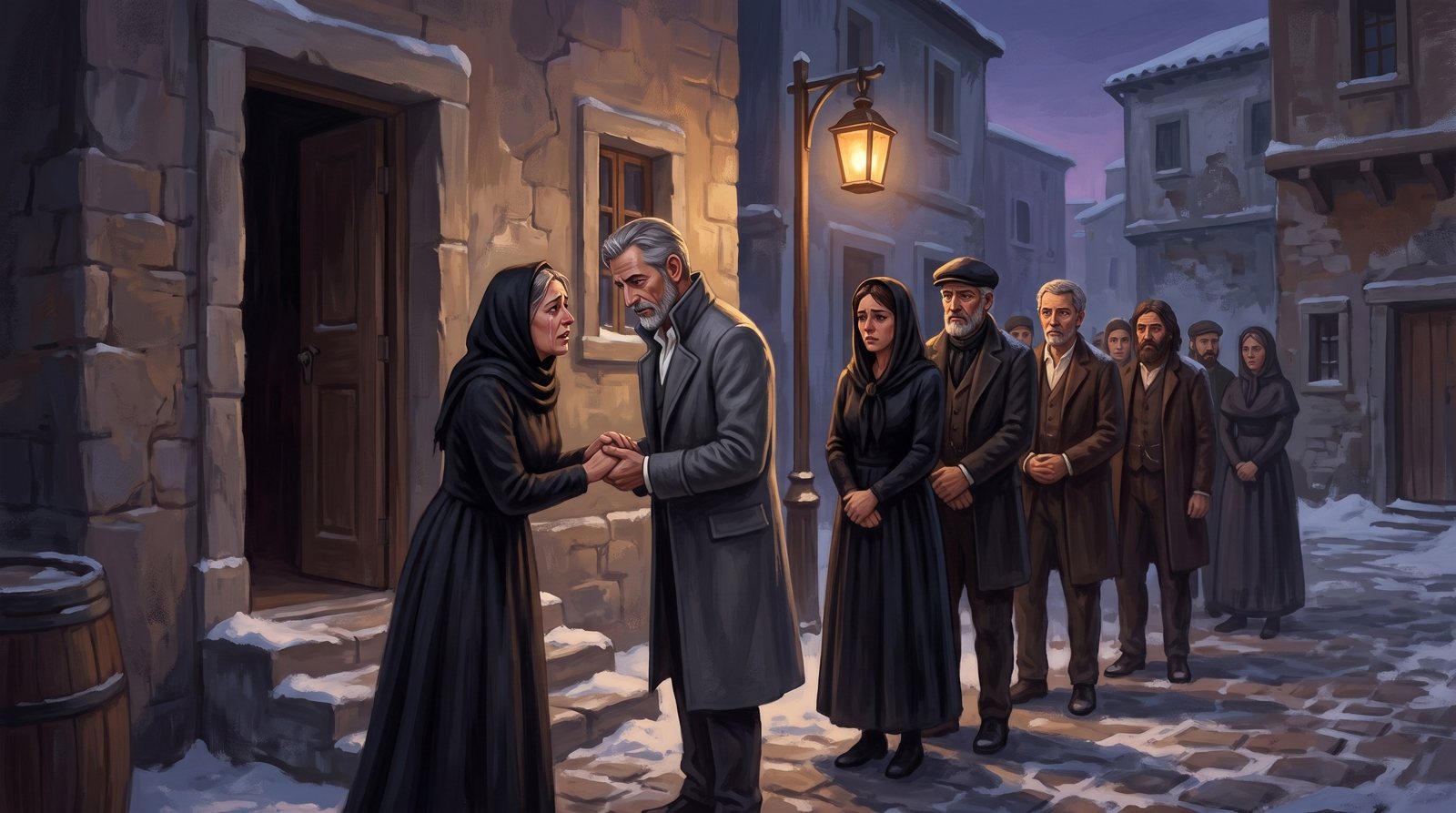
- Mare: "Sat with every family that winter. Held every hand. Never cried. Not once. Not even for his own."
- (Reference lines for the townsfolk's voice, STORY-MAYOR-2 and STORY-MAYOR-3; not all are scripted.)
Three readings
- Victim. His door was barred from the outside. The summons in his saddlebag ("The door is open. Come alone, and bring the key.") was sealed by a shaking hand. He hired help against the dead, and told a scholar he was afraid of what lay under his town.
- Accomplice. He paid a miller to look away from the lake lights. He asked about Stalvan's red stone. The bandits and the signal boy are paid in coins with the knot. He sits safe inside Ragosa while the coast burns.
- Culprit. The sightings don't add up: he was inside Ragosa before the gates shut, yet Luka saw him ride to the headland the night the party landed. A grieving father with a cut marionette. A man who laughs at supper in a city under quarantine. A grey coat in every place the party reaches a day too late.
Nobody in the party says it aloud. Vella comes closest, once, under Ragosa's walls: "Or there are two of him."
Quotes (as others remember them)
- "No one in my town will ever go without again." (to Jela of Masline)
- "Forget your own affairs; mind the town's." (his saying at every council)
- "The spring on the hill road, at the new moon. A closed cart, room for a long box, and no questions." (his letter to Vid the carter)
Beyond the prologue
The story, as you play it
In the prologue Ser Filip, the mayor of Stara Luka, is missing. He hired your party and was gone before you landed. His trail can be read three ways: as a victim's, an accomplice's or a culprit's.
You find him. In the final act you find him in the north, a thin and grateful "prisoner". He travels home with you.
Nana's table. At the inn in Stara Luka he tells a story from his boyhood. Stalvan heard that story, word for word, in his cell in Act 1.
How it ends Spoilers
The mayor is the Puppeteer. He is about three hundred years old: the child the town walled up alive in the plague year, behind a good man's face. He hired both crews and chose your party himself, to carry his thread and to come back at the end.
He raises the dead of Stara Luka over the last stone under the inn, and dies in the last fight. As your ship leaves at dawn, only Vella sees him. He is at peace on the mausoleum hill with his wife Dora and his daughter Mila.
Across the stories Spoilers
- The prologue's trail. None of the three readings the Prologue leaves open is wrong: he was the culprit, and he made himself look like the victim and the accomplice. The barred door and the overturned chair were staged. The sightings that don't agree were a dead man in his second coat, speaking in his voice. "Tell them I went to the capital" was the only true thing on the trail. He sat in Ragosa as an honoured guest while the coast burned, and laughed at supper.
- Where he is found (Unconfirmed). The notes say he is the Iron King's prisoner. After The Escape frees that king, the proposal is Jarnborg's high loft.
- After the slip. On the way down to the last fight the proof is everywhere. The names crossed out of the book of the dead are in the contract's hand, Mila's first. Mila's coffin in the rope-makers' vault is empty, and so are the nine rope-makers' beside it ("That's not a family. That's one man."). The chest under Mila's bed holds the cadet branch's seal ring, the knot with three hanging threads.
- Not decided: what the party does for him on the day it comes home, the shape of the last fight, and the family names.
The mayor is the Puppeteer. Ser Filip is the unseen master of the threads, the hand behind the hollow lich, the knot on the bandits' silver and the voice behind the dead king's mask. Nobody connects him to the Puppeteer until the final act.
He is about three hundred years old. He is the child the town walled up alive in the plague year, and a warlock of the Pact of the Thread: a bargain with the stone under the headland, a year of life for every life he gives it. Every rope-maker of Stara Luka since then has been him; the good mayor, about sixty, is his tenth face (STORY-MAYOR-4).
He is pure evil behind a good man's face. Every kindness the town remembers is an act, a purchase or a tool: he pays twice so that nobody can say he owes them; he remembers every name because he is counting the town; he sits with the dying to watch how they go. The one true thing in him is his love for Dora and Mila. It doesn't make him good. It makes him certain.
What drives him. The town shouted him down on the fever ship, buried his wife and daughter with its grain, and then came to his door, one family at a time, to forgive him. He never forgave the town. He wants the three stones, the ruler who never dies whom the dead obey, to have Dora and Mila back, and to put the town that killed them on threads forever.
How he is found out. At Nana's table, the night he comes home with the party, he tells a story from his boyhood that the party has heard before, word for word, in another mouth. Zanze has it written down. "What? Can you say that again?" … "You heard me well."
The whole story, his life, the two letters, the reveal and the last scene of the game are on The Puppeteer (spoilers).
- His name, his family name and his look: working names from STORY-QUESTS-1, awaiting the director.
See also
- The Puppeteer (spoilers) · Townsfolk of Stara Luka · Luka · Nana
- The Prologue · Side quests of the Prologue · The Patrician family
Sources: docs/plan/story_mayor_2.md (STORY-MAYOR-2 and STORY-MAYOR-3, the director's asks of 2026-10-26; the full quotes are on The Puppeteer page, which carries the spoilers); docs/plan/story_quests_1.md §2 (STORY-QUESTS-1, the user's ask of 2026-10-25); "plan - future for prologue.md" (Cast, mystery threads); the Chapter 1 script; pictures: references/concept/story_mayor_3/ and story_quests_1/ (Nano Banana 2, look-dev only).
Last updated: 2026-11-17 (SYN-REST: full synopsis, D-WIKI-SYN-2)
Categories: Characters · NPCs · Stara Luka