Ognjena
| Ognjena | |
|---|---|
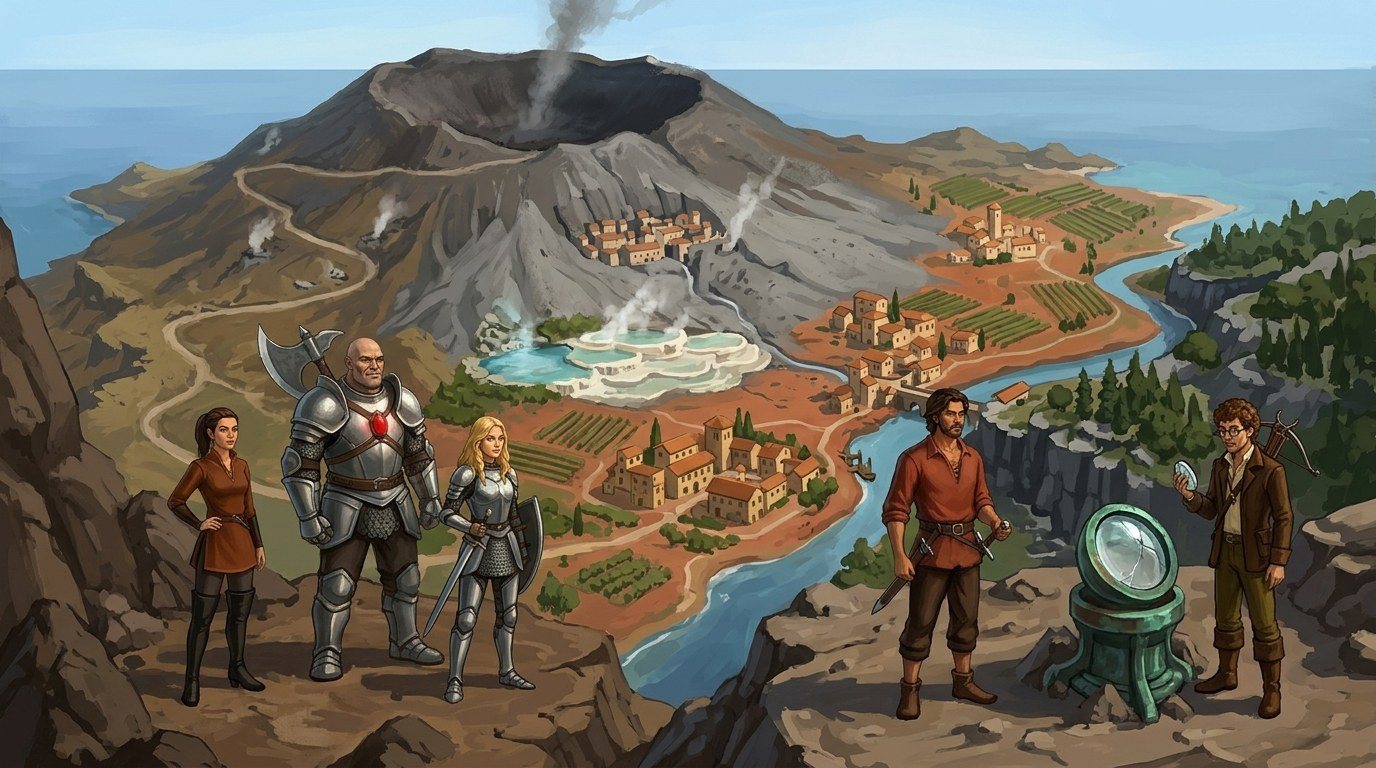 From the Noon Gallery (picture to come) | |
| Type | Volcano, 594 m; a watchtower (the Noon Gallery) |
| Location | Island 1, the north-east; the crater rim about (284, -1600), the Noon Gallery about (305, -1363) |
| Also called | the Grandmother (in the ash villages); the Hearth (the old empire) |
| Story | The Kept Fire |
| Status | Proposal for the full game (planned; nothing built). Part one is Act 2; part two is Act 3 and Unconfirmed — awaiting the director |
The story, as you play it
Ognjena is the island's volcano. In The Kept Fire you finally walk under it and then up it.
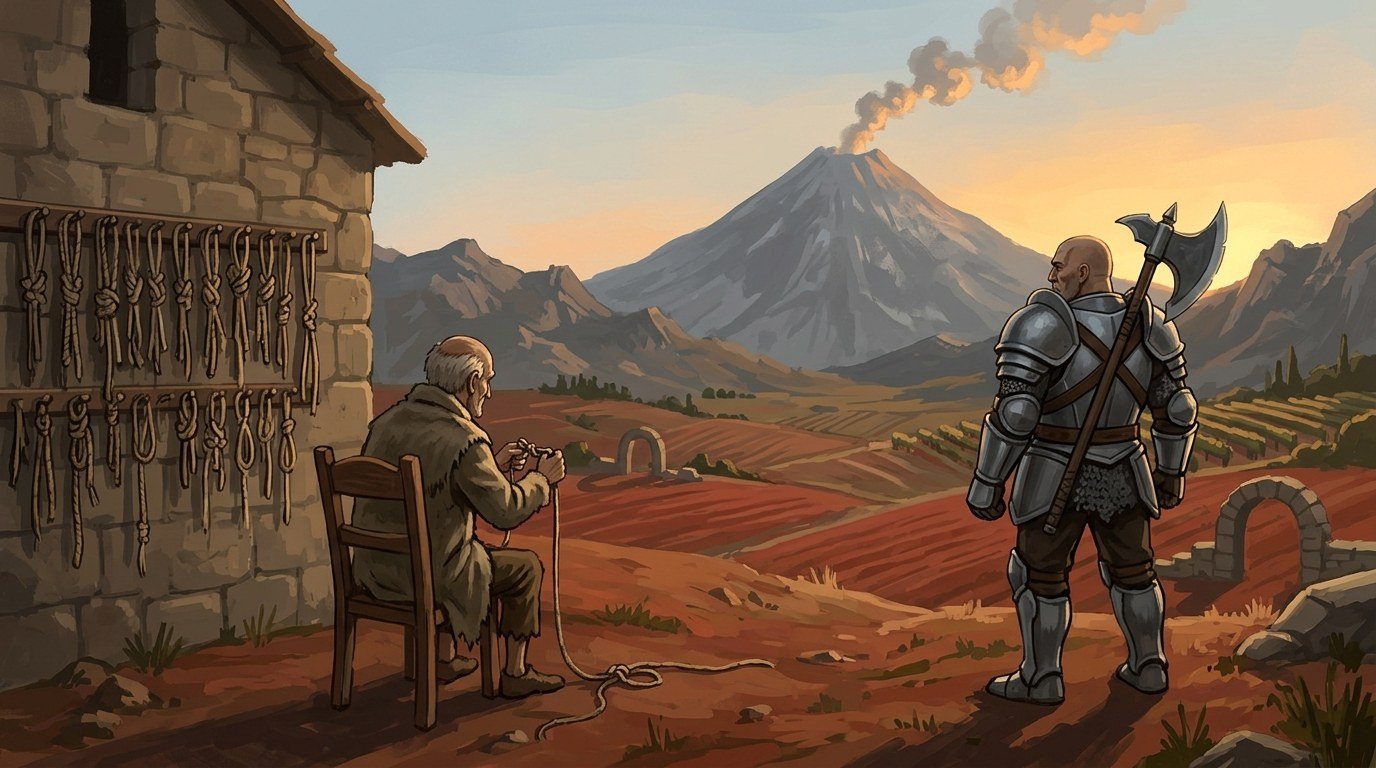
The Grandmother. The people of the ash villages never say its name indoors. Every house keeps one chair facing the mountain, and nobody sits in it.
The count. Anselmo, a hermit, counts its puffs of smoke every dawn and ties the number into a cord. From the day you meet him, his count rides in your quest tracker, and it climbs.
The climb (Act 3). You take the crater path past vents that hiss before they burst, to a slot high on the south flank where every scorch mark in the burned city points.
How it ends Spoilers
The volcano never burned the city. The old empire tapped its heat for the Forge and has had to damp it ever since; the count rises because diggers have disturbed the works. The slot is the Noon Gallery, where the smiths set a lens of stored daylight. At the end you choose: bank the fire, let it out north into the sea, or give it to the river.
Ognjena (working name) is the volcano of Island 1: the grey cone in the island's north-east that smokes behind every view, and the clock of The Kept Fire.
A design proposal for the full game: planned, not built, every name a working name. Coordinates are in Island 1's planning-map frame (x east, z south, metres) and wait for the map card.
The mountain
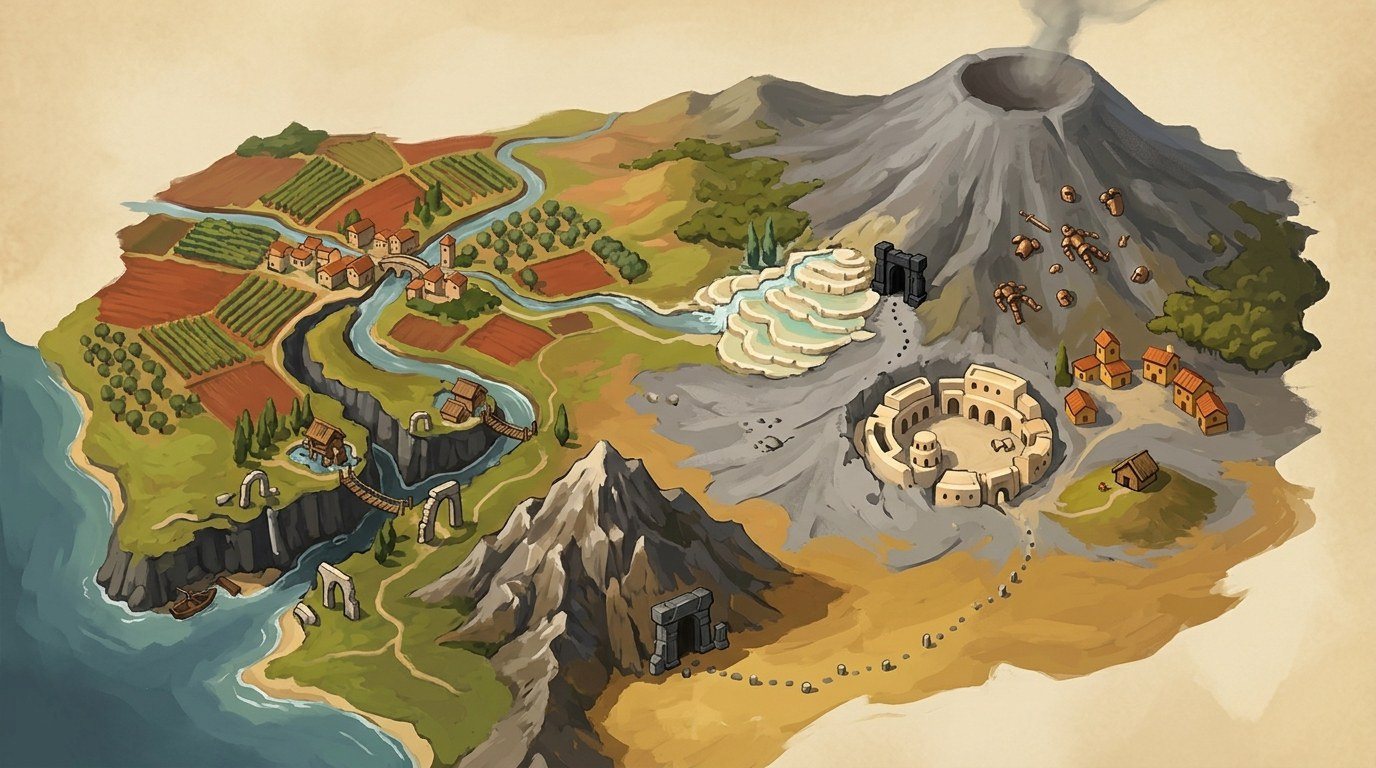
From above: a bare grey cone, 594 m, a round crater, a thin plume. The crater path (exists) climbs from the spring in long turns. The south flank looks at the polje; the north shore falls to the sea in black cliffs.
What it is to the people under it. In Le Braci and Acquatinta she is the Grandmother. Nobody says the mountain's name indoors. Every house keeps one chair facing her, and nobody sits in it. Hearths are banked at night, never put out and never left to blaze: "you don't out-burn her and you don't go cold on her." A child's first wine is poured on the black soil. None of this is worship; it is how you live with a difficult relative who owns the house.
What it was to the old empire: a furnace. They called it the Hearth, tapped its heat for the Forge through six shafts, and had to keep those shafts damped for ever after.
The Noon Gallery: a slot in the south flank, 12 m wide, with a bronze cradle that once held a lens the height of a door. The lens is still in it: spent, cracked, clear as water. The slot stands on the crater path, 413 m up, and looks steeply down: the whole of Cinerata lies under it, 270 m off, the square, the bath, Tilde's well and every opened street. The crater rim, 4.3 min higher, never sees the city; the cone's own bulge hides its foot. The gallery is Act 3's watchtower.
Le Braci and the Counter's Seat
Le Braci ("the embers"): twelve houses on black soil with the island's best vines. Style B (the interior: Siena-Tuscan stone and render, brown shutters), roofs swept of ash every morning. One chair on every porch faces the mountain. The Counter's Seat: Anselmo's hut (exists), one room, a rack of knotted cords down the whole back wall, one chair outside facing the mountain. The hut sits below the polje's lip, so the chair shows only the cone's upper flank and its smoke: no city, no gate, no town. It is all he needs. He counts the mountain's breaths by the smoke, and on thick mornings by the sound. His watchtower is the old tower 1.8 min up his road. From its top Cinerata, the Forge gate, Le Braci and Valponte show; the spring stays hidden in its hollow. He climbs it when a number frightens him, to see what the chair cannot.
The island afterwards
Later states add or block props; no path moves.
- In every ending: the gate lies open, or barred from outside (A). The forecourt and the slope below are strewn with three hundred empty suits. Ash lies a hand deep east of Valponte for a season; Le Braci's vines come up through it. The diggers' camp is empty tents.
- A: the plume as before. A new timber bar across the gate. Anselmo's chair is turned round, its back to the mountain.
- B: no plume. A black tongue of new rock on the north shore and a standing cloud of steam (the north shore has no paths). A rockfall closes the crater path above the Noon Gallery. Acquatinta's terraces are dry and white, the racks half empty.
- C: white steam from the gate, day and night. The Bistrica is low from the spring to the sea: stepping stones show at Valponte's stairs and in the gorge; two of Valponte's three mill wheels stand still. An old man sits by the fountain in Cinerata. Tilde brings him bread.
See also
- The Kept Fire · Quests of the Kept Fire · People of the Kept Fire · Enemies of the Kept Fire · The Klanac · The Bocca · The Forge · Ognjena · Cinerata · Valponte · Acquatinta · The Lamp · The Puppeteer · Island 1 · Portal: Locations
Sources: docs/plan/full_game/island1_fire_acts2_3.md (VOLCANO-STORY, 2026-11-18); docs/towns/world/island1_map.py (the planning map). Pictures: eighteen slots under wiki/_images/isl1_fire/, not painted yet.
Last updated: 2026-11-19 (FIRE-FIT-MAP: places, walks and sight lines brought to the planning map; earlier VOLCANO-STORY)
Categories: Locations · Island 1 · Full game (proposal)